Feature
How next-gen engines are going to squeeze every last drop of energy from their carbon fuels

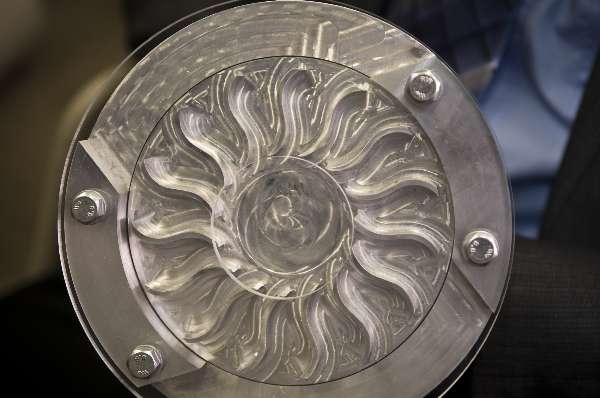
Wave Disc Auto Rambler

The internal combustion engine gets a bad rap these days. With electric vehicle technology finally coming to market in meaningful ways, oil prices spiking, global warming looming, and “green” sentiments pervading American culture, motors driven by exploding carbon chains have become something of a pariah. But the truth is that we’re stuck with the internal combustion engine, and the petroleum-derived fuels that power it, for the next couple of decades, at least. But that doesn’t mean we can’t still trim fuel consumption and reduce emissions across the board. Designers large and small are building wholly new engines and components that slash fuel requirements, waste less heat energy, and squeeze the most out of every BTU, every engine stroke, and every iota of chemical energy that physics will allow.

Indeed, the internal combustion engine is far from dead. In automotive design shops and university labs across the world the gasoline engine is experiencing something of a technological renaissance.


Click to launch the photo gallery

The green thinkers among us need not fear this resurgence of hydrocarbon-burning engines; these innovations aren’t just drastically driving down the amount of carbon-based fuel our automobiles might someday burn in a given trip--they are crucial bridge technologies that will help get us to that all-electric, carbon free future as cleanly and efficiently as possible.

Most of these are still in the concept stage, awaiting funding or for their prototypes to demonstrate that they are up to the job. None of them is a silver bullet, but each serves as an example of how internal combustion technology could extract far more from the increasingly costly hydrocarbon chains that they burn, drastically improving efficiency and trimming waste without sacrificing too much of the performance that we’ve come to demand from our automobiles.

In the last century, gasoline engines became ubiquitous. In this century, they will become smart. Click through to the gallery see seven ways it’s already happening.

Want to keep track of the latest concept cars, automotive innovations, and more? Subscribe to Popular Science today, for less than $1 per issue!

36 Comments

I hope this little engine can do all they say it can do. PoPSci spoke about this engine a while back. So, this is just a repeat of promotion for the engine. If it really can do all it can do, lets produce it and stop just promoting it.

Maybe if we water cool our incandescent bulbs, then run the heated water thru our house hold tap, we could probably double the life of incandescent bulbs! :p

The Regtech Radmax engine kills these designs in power to volume ratio. It runs on diesel too. Closest thing to it is the Mazda rotary, which is 3 times the size. Look it up.

In addition to building more efficient petrol driven engines much awareness needs to be directed towards sensitizing the people into the notion of using diesel powered vehicles. It not only has a far lower mileage, it also would recuperate the extra cost you spent on the car in a year (avg) in terms of fuel savings.

One thing we can do immediately is to enhance our combustion engines with OxyHydrogen on Demand from water. It does not replace gasoline, it increases its combustion efficiency from 13% to 98%. Time to go blue with OxyHydrogen on demand. Just add water.

I already read an article about this engine 6 months ago. Why is it whenever a great energy saving idea or fantastic inventions appear on popsci, they never actually are put into production!?!?

When I visited Brazil, they are ready figured out free energy. All the simple people who squat homes on the mountains or apartment complexes simply toss a wire over an existing power line to their home. Yes, sometimes people die. But when it works, that home has power. Then the next house taps it from his neighbor and so forth. They use the same concept to aquire water. Yes, free energy is abundant, " OPE! "

A Quote from Mr. Nikola Telsa "....In a letter to the editor of the Buffalo Enquirer, Mr. Nikola Tesla replies as follows in regard to an inquiry on the subject of the future of electricity: "The transmission of power has interested me not only as a technical problem, but far more in its bearing upon the welfare of mankind. In this sense I have expressed myself in a lecture, delivered some time ago. "Since electrical transmission of energy is a process much more economical than any other we know of, it necessarily must play an important part in the future, no matter how the primary energy is derived from the sun...." 1896.

In addition to the RegTech technology mentioned by dinkster (link here: http://www.regtech.com/home/ ), there's also the (admittedly more complex) Revetec engine, which can be seen here: http://www.revetec.com/home.html

There's also an engine that already has commercials for it over in Russia: http://www.youtube.com/watch?v=_PbLIQPK3wk (some say it's a total ripoff of the MYT engine invented by Raphial Morgado, but I'd say it could be just inspired by it)

I'm glad there are many bright people still working on improved versions of the horrendously inefficient internal combustion engine. Now if only some actual products would come out that can let people fly to school and work on a tiny budget...

@bubba gump. I was going to say. they did a story about this engine, what? 1 year ago.

I saw a product demo going exactly this way, called skyactiv. The car using it should be out next year.

If a couple of these designs can each produce a 50% increase in efficiency, why not combine them? Separate dual opposing pistons for compression and ignition, isolated for temperature, connected to an air tank, with laser spark plugs on the ignition side. I don't see why all of these innovations cannot be combined into one engine, barring the political and ego problems that would result.

How is this wave disc different from a turbine?

PopSci should check out what these guys are doing to improve efficiency combustion engines - VanDyne SuperTurbo
here's a link to a short video on their technology www.youtube.com/watch?v=DMz4MATUJxE

Patents have been granted for an engine that runs on inert gas. It has a sealed charge, no intake, no exhaust. I wish Popular Science would investigate and write an article about it.

scripturalphysics.org/qm/issues.html#PappEngine

How about the EXTERNAL combustion engine that you reviewed a while back? Burns literally almost anything combustable, with greatly reduced emissions. Raytheon is buying $400,000.00 worth of them that they will be used in under sea applications using a self oxygenated fuel (Moden fuel) The Cyclone engine may also have space applications as well. The Cyclone engine as it's called, is supposed to attempt to break the land speed record for steam driven vehicles next month at the salt flats in Utah and another cyclone engine is set to break the steam driven speed record for water craft at about the same time.

Tell Congress to convert a few trillion into algae production of ethanol and biodiesel, NOW.

It would start to solve the trade imbalance, cut CO2, create American jobs, consume heat and sunlight in the desert (sunlight/heat would be converted in photosynthesis) reducing or at least not making more global warming.

Better do it now before it is too late.

I'd like to have some biodiesel at 87 cents a gallon and it could be done with a few brave statesman and innovators.

I see a potential issue with the EcoMotors OPOC. Those long rods are a lot of reciprocating weight. They will have to be light and balanced very well. There's lots of exciting ideas here...it seems there are some brilliant thinkers designing engines.

Hopefully Big Oil won't buy up efficient engine designs and kill them. I suppose they could just triple the cost of fuel to make up the difference, too. A few years ago, oil companies reformulated gas to yield 3-4% less mileage than previously. I was getting a consistent 31 mpg, then overnight it dropped to 29-30 where it has stayed.

So it's not just about technology it's also about overcoming the hurdle of big oil, who understandably does not like declining profits.

As interesting as these are, what we need more than technology is just a shift in mindset.

We could easily double mileage using a few very simple existing technologies, which would have the side benefits of making cars cheaper and safer at the same time:

1 Govern all vehicles to the legal speed limit (70-75mph in most states).
2 Make all vehicles so-called "soft hybrids", which automatically shut the engine at idle, and restart upon stepping on the accelerator
3 Reduce weight on all classes of passenger vehicle
4 Reduce power on all classes of vehicle.

If saving fuel (with all that implies: national security, trade deficit, environmental impact, individual cost savings) and reducing fatalities were really important to either the manufactures or congress (not to mention consumers) all 4 of these steps would be no-brainers.

Since those clearly aren't priorities, the question is why will manufactures adopt any of these new technologies, when there is no pressure from either the market nor the government to make meaningful increases in efficiency?

Please bring us up-to-date about what is going on with the "water cars" nowadays? I recently read an article in the local newspaper about cars being powered by hydrogen generated from electroylysis of water by using the car's electrical system . Many of these appear to be scams, but they are becoming harder and harder to ignore because of credible reports of hydrogen being generated from water by various methods that produce hydrogen far in excess of the Faraday equivalents. Have the water car people tapped into this capability without really knowing it? This could be a very important resource.

I hope Popular Science will run a story on BOTH these topics. For a list of references see:

scripturalphysics.org/qm/issues.html#ExcessHydrogen

"I recently read an article in the local newspaper about cars being powered by hydrogen generated from electroylysis of water by using the car's electrical system . Many of these appear to be scams,"

They are all scams.

It's very simple. To create electricity, the engine has to burn fuel. You are trading chemical energy, stored in the hydrocarbon fuel, for kinetic energy. The kinetic energy is driving the alternator and converting it to electricity. The electricity is separating the water into hydrogen and oxygen. This a conversion of electrical energy into chemical energy. The hydrogen is burned, again converting chemical energy into kinetic energy. Every time you convert energy from one form to another, you have a loss. No energy conversion is 100% efficient. The process has four conversions, each is producing a loss in the amount of energy you get out of the original fuel (gasoline, most likely). This type of system can do nothing but cause your gas mileage to go down.

The first diesel engines were invented by Rudolph Diesel, in 1894, to run on hempseed oil.

An acre of hemp, growing without need for insecticides or herbicides, produces:
- 300 gallons of oil that can be used for food or fuel,
- 3 tons of residual presscake for animal feed,
- 1 ton of the strongest fiber for paper, rope or cloth.

Now, you know why hemp was made illegal... by petroleum, synthetic fibers, cotton, wood paper and corn feed interests.

The fear of global warming has done way more harm than petroleum has or ever could do.

Try run all electric vehicles in the Upper Northern parts of this country where we have sub-zero temperatures for a good part of the year. Batteries can and will freeze...Battery efficiency falls to the floor in sub zero temperatures. Try fire up a florescent light bulb when it's -20 degrees, guess what it doesn't work. Are we going to run all the tractors and combines on electric??? So you urban green idiots can continue to stuff your faces. So far the only diesel-electric combination that has worked is in a train. Good luck with that one.

I am looking for feedback here. Why not just make the engine run off water? Theoretically, if you can use the spark plug to generate plasma then inject that plasma into a water filled cylinder (the amount that gasoline engines have in each cylinder), the water would almost instantaneously be flashed to steam, the steam will expand and thus run just like a gasoline powered vehicle. Its clean since most of the product would be simple water and steam. If you were to run your exhaust pipe back to your water supply tank then you could recirculate the "fuel" and have really high mile per gallon on any vehicle.

@ davidsogge
the only reason that a train works so well that way is due to the fact that the electric motors are 3 phase and 3 phase power is more efficient than single phase. If we really want extremely efficient motors then we should use the gasoline engine to drive a generator that will produce +400Hz frequency @ 115V. A 400 Hz 115V 10Hp motor would be much lighter and smaller than a 60Hz 115V 10Hp motor. Its far from perfect but it's a worthy shot.

I am missing the so-called variable compression engine. Different revs actually require different pressures in the combustion chamber. The best way to achieve this is to have the chamber's volume vary dependent on the revs the engine is making.

I see no reason why these concepts cannot be merged, save the shockwave engine. Moreover, I've heard of a computer controlled super+turbocharger, or the turbocompunding, or even using Zeolite (the stuff used to concentrate oxygen for people with heart failure). Here is another link: www.popularmechanics.com/cars/news/4270120?click=main_sr
I also see no reason why these idea's shouldn't be forced on the car companies right now.

"Govern all vehicles to the legal speed limit" Why doesn't it surprise me that you're from Cali, Jacob?

Government is as bad as the oil companies. We don't need more regulation- we need the freedom to innovate.

Car companies don't want to build fuel efficient cars because it costs more money to do so. That results in less sales. They'll only make money if the price of gas is high enough that the consumer will find value in paying extra for a fuel efficient car.

For example, given the cost premium of hybrids, if you factor in how much you'll save in gas, it'll take 10 years to recoup your expense (yes, depends on model, driving conditions, and price of gas; but you get the point). Plus you can find many cheaper gas-only models that claim 40mpg.

I lack an engineering background, so I don't fully grasp how all these work, though I do get the underlying ideas -- and they're very intriguing.

The point has already been made that barring some entirely unforeseeable development, the combustion engine is going to be around a good while yet. I'm very green-oriented, but I'm also practical, so I accept it. With efficiency improving all the time, the combustion engine can be a foundation upon which to build to see us through until we have EV's, hydrogen-powered vehicles, perhaps even solar-powered ones, etc. to take over the heavy lifting the combustion engine does for us now.

I would like to see more effort put into alternative energy than is currently being devoted to it, though in the current climate (in the U.S. anyway), that is probably something of a pipe dream for at least the near term.

Interesting article -- thanks, PopSci --

@ManOnFire6469

There is no "fear" of global warming, there is merely forward thinking, long-term minded realizations that having an infintie growth paradigm in a finite system is foolish. It may not be right now, but at some point in the future, petrol will be 100% unavailable as an efficient energy source.

When that time comes, we can either be prepared with highly efficient alternative energy sources or the entire planet's human population can drop by roughly 80% when there is no longer sufficient energy resources to sustain people's lives. It will be the greatest human tragedy in recorded history, far worse than WWII's atrocities by a factor of 100's, if something preventitive isn't done ahead of time.

I completely agree with many of the previous comments on the unreliability of the traditional and variations of the piston engine.Now in the past turbines have not been efficient but that was to generate direct drive energy.In this instance the turbine would be set to run at its optimum power/fuel ratio.Even if it were not very clean the fact that it would be designed to operate at a set speed for optimum efficiency the emission control system would be designed accordingly.Plus a combustion engine of this type could theoretically utilize multiple fuels.So to design it to run on a fuel that is less polluting, say hydrogen, diesel/urea, ethanol or what ever other promising super fuels may come.Plus the fact that if I am correct the secondary systems that also produce waste products like say....oil for lubrication.even if it still required regular oil would need far less than a contemporary recip engine.or any other engine in general.the compact size of this engine versus the smallest recip electric generating setups now means more battery space in new hybrid cars.
Now to address the issue of storage capacity in batteries.

Everyone is concerned that a practical long distance driving battery may never be available.
I have always wondered why no one ever took the approach of the typical toy car.
A battery that is replaceable when it is low.
I envision a battery station that could be almost completely automated.
You pull off the freeway when the low voltage warning comes on, Pull into the station and park in a designated battery replacement area, A simple system of visual tracking devices positions either the car or the necessary equipment.the automated system locks on to the "battery pack".Unfastens it, removes it, installs an already charged one and releases your car.your back on the road in moments.In the meantime the battery that is coded and shows a complete history of who has used it, how long, charge cycles etc goes into diagnostic, is serviced if needed, then recharged and put into standby for the next depleted user.
This is a completely viable and doable option.
If we go completely electric that is.

@ Phillip Faugno:

Your idea is not only not new, it is already in use. It's called "A Better Place", and is already functioning in Israel as well as other locations.

The problem with such a scheme is universality-- look at the EVs already on the market-- the battery pack for the Chevy Volt, for instance, is long and T-shaped, occupying a tunnel down the middle of the car. That is an efficient shape to utilize the space on that car, but would be difficult if not impossible to design to be extracted or replaced in something similar to a "Better Place" setup. And the battery pack for the Tesla Roadster and S Model, as well as the i-Miev, Nissan Leaf and other EVs all have battery packs designed to make the most efficient use of space for that vehicle and its intended charge capacity. There is unlikely to be any "one size fits all" solution. To make one or two battery packs intended for use in all vehicles severely constrains the design possibilities.

Better Place will find a niche, but only with people that find that particular vehicle design will fit into their lifestyle.

I sincerely hope the Michigan State "Shock Wave" engine gets further than just an idea in Norbert Mueller's head, but the more time passes without news about that design, the harder it is to maintain optimism. There may be inherent problems in that design that they have since discovered. I do hope they put something on the market soon. One curious aspect of that design is that it would help jump-start not only hybrid production, but give us a bridge to what we really need-- a fully electric car.

That design would work well for hybrids, but would be nearly useless for a vehicle powered exclusively by fuel, due to its narrow RPM range at which it can operate efficiently. It is ironic that any fueled engine could help foster the growth of EVs.

The upside of this forum, giving anyone the opportunity to respond to articles in PopSci, is that we can freely share ideas with one another. The downside is that there is a steady stream of useless or duplicate ideas endlessly promoting perpetual motion and "over unity" devices, cars that run on water or unobtanium, and designs that have long since been proven to be impractical, unworkable, dangerous or otherwise unusable.

seems http://google.com knows it well

TEJJ IC ENGINE
(CONSTANT TORQUE RECEPROCATING IC ENGINE)
In all IC engines built so far, the reciprocating motion of the connecting rod
is converted in to rotary motion for wheel through crankshaft. This was most appropriate technology when the engine was invented. However, with continuously rising fuel prices around the world, many attempts are being made for improving engine efficiency.

I have studied existing technology in detail & have found out following disadvantages with existing system.

DISADVANTAGES IN EXISTING SYSTEM
1. The torque generated is always in a sine wave form.
2. Although, fuel combustion exerts tremendous force on piston from TDC to BDC (can be considered constant for any particular power stroke); all of it is never converted in to desired torque. When piston is near TDC or BDC, the force is wasted in compressing / stretching crankshaft radial arms towards / away from crankshaft bearings. Due
to this repetitive cyclic force, crankcase is required to be designed adequately strong & robust for bearing non converted force from Pistons.
3. Due to sine wave nature of torque conversion, maximum torque is available ONLY AT CRANKSHAFT ROTATION AT MULTIPLES OF 90 deg..
For all other times, the torque available is LESS THAN MAXIMUM POSSIBLE.
4. For a 4 cylinder engine with cranks placed at 90 deg. apart & firing order 1,3,2,4; cylinder 1 (say) has power stroke from 0 deg. to 180 deg.of crankshaft rotation; then other cylinders will fire as under
• Cylinder 1: 0 deg. to 180 deg..
• Cylinder 3: 180 deg. to 360 deg..
• Cylinder 2: 270 deg. to 450 deg..
• Cylinder 4: 450 deg. to 630 deg..
For cylinder 1, next power stroke starts at 720 deg. only & hence it can be seen that from 630 deg. to 720 deg., there is no power available in any of the cylinders. Engine has to cross this zone only by means of inertia of the over all system.

Considering all these disadvantages, I have developed a new concept in IC Engine, which WILL NOT HAVE ANY OF ABOVE DISADVANTAGES.
I have named it TEJJ IC ENGINE having following advantages:

ADVANTAGES OF TEJJ IC ENGINE
1. This Engine WILL PRODUCE CONSTANT TORQUE OVER ALL
POSITIONS OF CRANKSHAFT ROTATION. Torque wave will be a
rectangular one.
2. The torque will be comparable to that of ELECTRIC MOTOR.
3. As no force from piston will be wasted in exerting undue force on crankshaft bearings, crankcase design can be made relatively lighter.
4. Torque available will be EQUAL TO MAXIMUM POSSIBLE TORQUE of existing sine wave torque at 90 deg. multiples.
5. This engine can be easily made in existing plants since It is only addition / modification of components & rearrangement of existing engine using ALREADY PROVEN COMPONENTS ELSE WHERE.
6. No new technology yet to be tasted is used for this invention.
7. Work done PER POWER STROKE of ENGINE WILL BE ALMOST 55%
HIGHER THAN THAT IN AN EXISTING SINE WAVE IC ENGINE.
8. This will lead to TREMENDOUS INCREASE OF ENGINE EFFICIENCY / MILAGE FROM VEHICLE.
9. This Engine can be used for all IC engine applications as at present.
10. This Engine can be used for all 2-stroke / 4-stroke engines running on ANY FUEL.

IN CASE ANY INDIVIDUAL / INSTITUTE / MANUFACTURER IS READY FOR SPONCERING DEVELOPMENT OF A PROTOTYPE OF THIS NEW ENGINE;
KINDLY CONTACT ME ON MOBILE NUMBER 919424140739 OR E-MAIL
Rp_naik@in.com. I assure that concept is fully ready with drawings, animated presentations etc & only shop floor designing / manufacturing is remaining.

Links with relevant graphics are available at “www.scribd.com/doc/49011286/TEJJ-IC-ENGINE-Constant-Torque-IC-Engine”.

This stuff needs to happen soon! The auto industry needs to evolve. Gasoline is not the only thing on earth. Push those dicks into using methane or algae for cars! The future is in our hands!


June 2013: American Energy Independence

Five amazing, clean technologies that will set us free, in this month's energy-focused issue. Also: how to build a better bomb detector, the robotic toys that are raising your children, a human catapult, the world's smallest arcade, and much more.


Online Content Director: Suzanne LaBarre | Email
Senior Editor: Paul Adams | Email
Associate Editor: Dan Nosowitz | Email
Assistant Editor: Colin Lecher | Email
Assistant Editor: Rose Pastore | Email

Contributing Writers:
Rebecca Boyle | Email
Kelsey D. Atherton | Email
Francie Diep | Email
Shaunacy Ferro | Email

circ-top-header.gif
circ-cover.gif