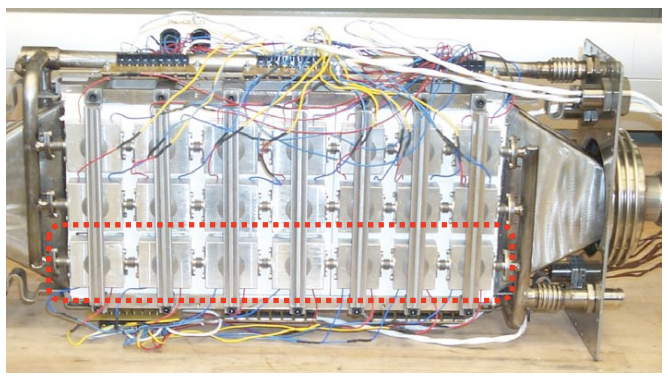
General Motors Thermoelectric Generator This module could capture waste heat in your car's exhaust and convert it to energy, improving fuel economy in a Chevy Suburban by 3 percent. GM

Engineers are making strides toward cars that can use their own waste for energy, testing BMW, Chevrolet and Ford vehicles outfitted with heat-collecting devices that can improve fuel economy.

In most vehicles, around 40 percent of gasoline energy is wasted as heat — you have to burn gas to make the car go, but there’s no way to capture the radiant heat of the act of combustion. Exhaust gases can reach 1,300° F. Thermoelectric devices integrated into a car’s exhaust system could capture this heat, but it's difficult to design generators that can withstand the huge temperature differential required to produce a current.

Improved devices that use rare earth metals and super-strong alloys could produce a few hundred watts of energy, improving fuel economy by 3 percent, according to initial tests at General Motors.

Technology Review reports on efforts at BSST, a thermoelectric-device maker in California, and at GM’s research labs in Michigan. BSST is testing compounds made of hafnium and zirconium, which can withstand the high temperature differential. GM’s project is getting out of the lab, where we first saw it last fall, and into a Chevy Suburban. GM’s thermoelectric research has centered on skutterudites, cobalt arsenide minerals doped with rare earth elements like ytterbium.

Computer models show the device could generate 350 to 600 watts for city and highway driving, respectively. This equates to a 3 percent improvement in fuel economy, according to GM. That's not great for a system that requires expensive and difficult-to-obtain rare earth metals, but further testing could yield even better mineral formulas with even greater efficiency.

In its first tests this spring, GM sliced out a section of a Suburban’s tailpipe and welded in the thermoelectric device, which looks like a muffler. GM scientist Gregory Meisner tells Technology Review the next design would be better integrated into the vehicle’s exhaust system, rather than added at the back end.

It could still take a few years for the devices to be integrated into new cars, Meisner said. GM's goal is to achieve 10 percent improvement in fuel economy by 2015 without increasing emissions.

[Technology Review]

Want to keep track of the latest concept cars, automotive innovations, and more? Subscribe to Popular Science today, for less than $1 per issue!

12 Comments

Interesting as there is a lot of wasted energy, but I wonder how much waste building these parts and repairs will cause in and of itself, and if and how it will increase maintanence on auto vehicles. There is a point where if there are to many moving parts to maintain that can break down, it might just be easier looking at other technology.

I have heard of electric cars that can run for 80 years.
Improving fuel economy by 3% seems like a small improvement compared to just using an electric car that could get most energy from a renewable source and of the toxic oil. Still, a step in the right direction. They could also put electricity generators on the wheels on that note I imagine.

Not to mention, that in scenerios such as a vehicle at high elevation, there is tons of unbured hydrocarons as a result of the low oxygen to fule ratio. There could be up to 40% worth of unburned hydrocarbons in gas emmissions. If you want to solve a problem, find a way to improve that ratio, or collect left over gas.

@1134

Thermoelectric devices are solid state with no moving partings. When heat flows through the system an electrical current is created. Conversely when a currently is applied a heat flow is induced-a heat pump without the compressor . That latter effect is used in portable electric coolers and heaters. I have a 12 volt electric cooler that can keep things at up to 40F below the outside temp.

Typically these devices have very low efficiency converting around 10% of the heat flow into electric current, or 10% of current into heat flow. Researchers have been looking for higher efficient thermoelectric circuits for decades. It seems some of the research is finally paying off.

I can't say how much cost this might add to a vehicle, but the materials they are talking about are not cheap

The Model T Ford got 25 mpg. Its production ended 84 years ago. The best our USA Car Manufactures can do for me now is selling me a Technology Space Shuttle Car. It’s all about greed and sales. They are not focus on the consumer. They only change, when some outside force forces the Car Manufactures to change, not before. Henry Ford had a true vision of taking care of a USA consumer need. Everyone else is just focus on money.

I adore PoPSCI, I loathe PoPSCi

spam filter. Dear PoPSCi, you spam filter is annoying,

defective and broken. I have never send spam on your

website, urls, links. Please fix you spam filter, thank

you. Just maybe, just maybe this comment will make it

through. The fact is, I have tried to send this

paragraph several times. It was orginally written in

notepad too, plain text.

What about the Cyclone WHE ? It has an efficiency of 30%,few moving parts,and can be very compact in size.It would recover a lot more waste heat energy from an ICE than a thermoelectric device,and it doesn't use rare metals.It can use any heat source over 500 degrees.

If the auto companies offer me a job, where I can work from my home, I save a whole lot on gas. " Ope! "

@cholin3947 thanks for the clear explanation! Good info.

produce steam from the heat with water much cheaper and more power

"produce steam from the heat with water much cheaper and more power"
That is how the Cyclone WHE works.It is a modern closed loop steam engine.

"The Model T Ford got 25 mpg"

But that was a car that didn't have a starter, heat, A/C, power windows/doors, safety equipment, emissions control, etc. Also much slower acceleration, lower top speed, less comfortable, etc.

I'm sure that if a model T was built using modern tech and materials, but none of the creature comforts and safety features, they'd be able to get really good fuel economy, though the gov't wouldn't allow it for sale in the US due to the lack of safety and emissions...

It looks like this is the mechanism GM is currently contemplating for heat harvesting:
www.techperse.com/2011/05/gm-seeks-patents-to-harvest-vehicle.html


July 2013: The Future Of Flight

The incredible innovations, like drone swarms and perpetual flight, bringing aviation into the world of tomorrow. Plus: today's greatest sci-fi writers predict the future, the science behind the summer's biggest blockbusters, a Doctor Who-themed DIY 'bot, the organs you can do without, and much more.


Online Content Director: Suzanne LaBarre | Email
Senior Editor: Paul Adams | Email
Associate Editor: Dan Nosowitz | Email
Assistant Editor: Colin Lecher | Email
Assistant Editor: Rose Pastore | Email

Contributing Writers:

Kelsey D. Atherton | Email
Francie Diep | Email
Shaunacy Ferro | Email

circ-top-header.gif
circ-cover.gif
bmxmag-ps