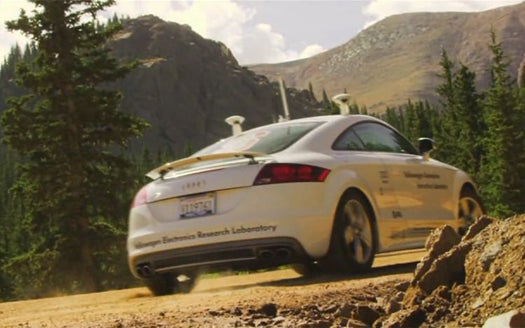
Stanford's Pikes Peak-Climbing Audi TT-S Stanford University has a long tradition of building autonomously navigated cars, like this Audi TT-S designed to race the famous Pikes Peak Hill Climb. Now, researchers from Stanford and Carnegie Mellon University – itself no stranger to building autonomous vehicles – have teamed with Google to build a fleet of robotic vehicles that negotiate traffic without human intervention.

Google’s self-driving cars aren’t even close to being commercially available, but that doesn’t mean the company isn’t paving the way for their eventual rollout. Google is lobbying for legislation in Nevada that would make that state the first in which their cars could legally be driven on public roads, the NYT reports.

The proposed legislation is actually split between two bills. One is an electric vehicle bill to which Google is trying to attach an amendment allowing for the licensing and testing of autonomous autos. The other--less important for the vehicles themselves but likely more important to some potential future passengers--is an exemption to the existing law that prohibits texting while in the driver’s seat.

Google’s cars have already been logging dubiously legal test miles in California, where it was revealed last year that the company had road-tested robotic vehicles on more than 140,000 miles worth of asphalt, including iconic Highway 1. Of those, more than 1,000 miles were driven completely autonomously, and it’s safe to assume Google’s six autonomous Prius’s and one Audi TT have logged more miles since that October announcement.

But why Nevada and not California? And why now? Google execs aren’t saying and your guess is as good as ours. But if the driverless car is the future of automobiles it’s not a bad idea to start the legislative process now. Before autonomous vehicles become a commercial option, rigorous licensing standards, safety reviewing processes, and performance testing standards all have to be put into place, and all that has to happen somewhere first.

[NYT]

Want to keep track of the latest concept cars, automotive innovations, and more? Subscribe to Popular Science today, for less than $1 per issue!

12 Comments

Didn't Mountain View "win" the right to have free wifi courtesy of Google ? Maybe Google should have picked Vegas instead.
Congrats on Google for taking the steps now, albeit with alot of caveats for sure.

My guess why they would do it would be for the advertising dollars. Billboards line all the streets and highways. Google wants to do the opposite, make the highway one continuous billboard.

If they are first, they can control it and set their own standards. Allowing for texting while in the drivers seat means that you put a car in Autonomous mode that is equipped with a heads up display dashboard and a keyboard console, with unobtrusive ads popping up on your display as you travel.

Why they would choose Nevada? Perhaps for those on a Vegas road trip. Or there is a major upgrade to the Highway systems there coming up and test result where the highest in that State.

So if an autonomous car hits someone or causes an accident who does the cop write a ticket out to? Seems illegal no matter what they do which same with red lights that snap abusers running red lights and depend on the photo of the driver to ticket the driver. You cannot ticket a car! So if a friend borrows an autonomous car for kicks and it runs a red light does the owner get the ticket? No, that is illegal.

Seems you have a legal nightmare here and if someone is hurt by a car such as this the lawsuits would be astounding.

@gizmowiz, I believe that your insurance covers your car. If your car is parked and someone runs into it, or if your car rolls down a hill without someone in it, you are insured.

In the case of Autonomous Cars, I would suspect that the same law of 'Care and Control' of the vehicle would still apply.

I agree that there does have to be some major reworking of the law. The lawmakers would argue that regardless, the person behind the wheel is responsible...and there would always have to be someone behind the wheel.

During the first few years I would imagine that there would be a law stating that you are not allowed sleep while behind the wheel. You have to be able to take control of the vehicle.

@gizmowiz
Same thing as happens now. Human owner is innocent until proven guilty. The car is examined for poor maintinance or illegial modifacations. The blackbox is also examined and tested. The only difference is that the police will be able to see the accident from the 'drivers' point of view.

If everything works it's a freak acident, and no one gets a ticket. If there's a failure that the owner couldn't have predicted, then they'll be formally cautioned not to use autopilot until the relevent software patch is issued.

Most likely outcome is that the police will extract video recordings of either a pedestrian or another motorist doing something monumentally stupid.

jefro "Hello car."

car "Hello jefro"

jefro "Take me to the bunny ranch"

car "I'll have to get some new tires or tell your wife"

jefro "Oh %#$Q@#@#"

I am pretty sure people stink as drivers but I am in IT. I would never trust a computer to drive. Sure, we sold some to FAA to do approach but they were very redundant systems. How is a 12 way redundant system going to fit in a car?

Better idea than Chrome.

My father drove over a patch of ice, slid into the on coming traffic and died.

Once Google has perfected their autonomous cars what will the accident rate be like when compared to humans?

Theoretically autonomous cars should be able to pay attention to more sensory information than humans, including ice detectors, live satellite feeds, radar, infrared, multiple cameras, intra-car warning systems, etc. Also they will not drive when tired, and can't get drunk. If the accident rate for autonomous cars is even 20% better than for human drivers, then when an accident is caused by an autonomous car, should we really blame autonomous cars for killing people or praise them for saving 20% more lives than human drivers?

As the autonomous cars get better each year, updated with better software and hardware, they will likely be thousands of times safer than human drivers. I, for one, do not wish future children to be losing their fathers because of human error in 2040. Especially when the technology to prevent it is just around the corner as of 2011.

Bad Idea...
You know one day this car will be bought by a 20 year old kid living with his parents named Drake, and you know Drake is going to put a giant un-needed spoiler on the back and a brand new stereo on the car. and while Drake is installing this stereo he is going to clip a wire he shouldn't. and do you want to be driving down the road knowing drake has been cutting wires on his car???

I dis-like Edison...

computers fly airliners, this should be easy, most of the concerns noted are more likely an "i want to be in control issue", rather than a "public safety issue", most drivers suck at driving, obviously a computer could do a much better job, just always being alert is a major step forward, if you just have to drive, i'm sure there will be places to do so, besides, it could drive you home drunk :)

this is what we need now. safer cars and no more alcohol related accidents and deaths and no more car crashes due to sleepy drivers coming from work late.

@Nikola Tesla:
Don't be foolish. Self driving cars will have distributed digital control systems, just like modern cars have, but more extensive. In other words they'll be computers, and if you cut a wire in part of a computer, that part stops working, and the computer knows and tells you, or the computer doesn't boot.

The key difference is that the car will tell Drake exactly where the problem is, whether local law allows the car to be driven in its current state, and ask does he want to google for a spare part and/or local service centre? (Or alternatively, nothing happens, and then Drake has a Doh moment and plugs the battery back in.)

That's assuming that he can physically cut the wire, that the wire isn't clearly labeled, that it's the same shape, and size as a power cable, that it's in the same location, and that the car's network system doesn't include some kind of ring main principle.

You can't make things idiot proof, or hacker proof, or murphy proof, but you can usually make things reasonably fail safe proof.


June 2013: American Energy Independence

Five amazing, clean technologies that will set us free, in this month's energy-focused issue. Also: how to build a better bomb detector, the robotic toys that are raising your children, a human catapult, the world's smallest arcade, and much more.


Online Content Director: Suzanne LaBarre | Email
Senior Editor: Paul Adams | Email
Associate Editor: Dan Nosowitz | Email
Assistant Editor: Colin Lecher | Email
Assistant Editor: Rose Pastore | Email

Contributing Writers:
Rebecca Boyle | Email
Kelsey D. Atherton | Email
Francie Diep | Email
Shaunacy Ferro | Email

circ-top-header.gif
circ-cover.gif
bmxmag-ps