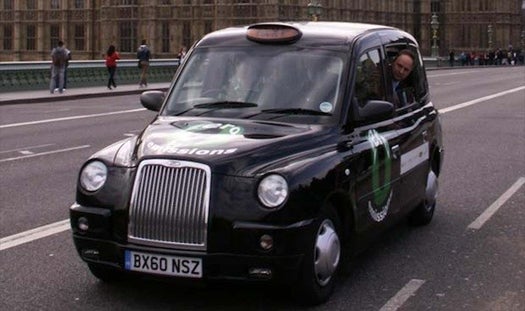
London’s iconic black cabs are getting a green upgrade in time for the 2012 Olympic Games, and the first street legal iteration just took to the streets. Developed by Intelligent Energy, this is London’s first cab powered jointly by a hydrogen fuel cell and lithium polymer battery packs.
The combination fuel-cell/battery pack offers the cab enough power to get around London’s congested byways for a full day (range: 250 miles). It’s not particularly peppy (zero to 60 in just fourteen seconds!) but for a city-trawling cab its 81-mile-per-hour top speed is more than sufficient to get Brits from here to there in a timely fashion.
The idea here is to deliver a fleet of clean cabs to the street before the 2012 Games get underway next summer, and Intelligent Energy claims they are on track to do exactly that. Which is a good thing. Once the Brits have upgraded their cabs, they can focus on other things that could use a redesign. Like that 2012 Olympic logo.
[engadget]
Five amazing, clean technologies that will set us free, in this month's energy-focused issue. Also: how to build a better bomb detector, the robotic toys that are raising your children, a human catapult, the world's smallest arcade, and much more.


Online Content Director: Suzanne LaBarre | Email
Senior Editor: Paul Adams | Email
Associate Editor: Dan Nosowitz | Email
Assistant Editor: Colin Lecher | Email
Assistant Editor: Rose Pastore | Email
Contributing Writers:
Kelsey D. Atherton | Email
Francie Diep | Email
Shaunacy Ferro | Email
1st!
I love how humans need an excuse to do something like this especially when the inspiration is semi-irrelevant.... Sports!!!! Lets make actual clean cars and target it on the date of the Olympics to look cool. Granted... of course it does set a standard and inspire for the greater good globally. I just don't see why we need an excuse to set standards and apply something that seems like a "no brainer"...right? Shouldn't every large city like London or New York be doing things like this already? A total clean switch over? Should't the current results of pollution be enough of an "excuse" to think ahead? I guess not. None the less. hip! hip! hazaa! At least its happening.
Shouldn't*
Please change the "First" to the "Third"!
What is the problem with regurgitation these days? No one can research an article before spewing up someone else's drivel?
The FIRST fuel cell powered taxi. Really Endgaget, Really PopSci? Do you hire anyone to research technological claims? Because I'm afraid if you did you'd find that in 1998 my father in law drove members of Parliament around Marble Arch in the actual FIRST fuel cell taxi. An alkaline hydrogen fuel cell taxi made by the now defunct Zetec Plc.
www.favstocks.com/zetek-efforts-on-fuel-cell-london-cabs-reach-back-to-1998/0822384/
www.siteselection.com/ssinsider/bbdeal/bd010528.htm
I'd ask that you'd remove the "FIRST" as it is misleading, incorrect and dishonest. Please give credit where credit is due.
What is also of note and possibly far more interesting is where the hydrogen for the taxis is being sourced? Waste remediation? Agal bio-production of H2? As a byproduct of Sodium Chlorate plants? I'd wager that the hydrogen produced to power these taxis is vastly more expensive and non carbon efficient.
-Nathaniel
Street legal seems pretty clear dude. From what i see the title is dead on go qq on some one elses site. Have a good day now
Looks like madeintaiwan is one of those angry tards that can't read past a headline.
"London’s first cab powered jointly by a hydrogen fuel cell and lithium polymer battery packs"
and an oil=lovin tool too
Also it says first black cab so the title is right douche cuz the one you are moaning about is not black. Way to fail at life.
@Gregg_NJ- Excellent representation of your level of social and technological understanding. By "Tard" I'm assuming you mean "Retard" which I'm afraid if you are using it as a verb I'd argue that I'm the exact opposite. Maybe you can call me a "pel" as in "propel"? Or a "lop" for "develop"? Or perhaps we can leave name calling to a younger age group. Like children.
Technologically most if not all fuel cell powered vehicles are hybrid systems that utilise a combination of batteries, electric motors, charge controllers, dc to dc converters, BMS systems and fuel cells. The "First" (now pay attention Delkomatic because this pertains to you too) London taxi that was street legal was made by Zetec more than ten years ago. So reposting this article in Popular Science is false and not very well researched.
@Delkomatic- Firstly if you are going to insult me please make an effort. From the font of all wisdom- wikipedia defines 'Black' cabs: "Motorised hackney cabs in the UK, traditionally all black in London and most major cities, are traditionally known as black cabs (which they were), although they are now produced in a variety of colours, sometimes in advertising brand liveries (see below). The 50 golden cabs produced for the Queen's Golden Jubilee celebrations in 2002 were notable."
So when this article says 'black cabs' it is referring to a fleet of taxis that are painted the traditional black but if you've ever been to London or perhaps seen it on your preferred cubical display then you'd know that 'black cabs' can come in all sorts of colors. As the actual "first london fuel cell taxi" was, which again was made by Zetec in 1998.
Still don't believe me? Here's a book:
www.books.google.com/books?id=HXDBf5cmUf4C&pg=PA119&lpg=PA119&dq=alkaline+fuel+cell+taxi&source=bl&ots=pbuZlqyMCH&sig=jciDCXLn4PGfK85etAWXByeBfys&hl=en&ei=r2mgTZ2IIo7ViAKpnbXuAg&sa=X&oi=book_result&ct=result&resnum=8&ved=0CFIQ6AEwBw#v=onepage&q=alkaline%20fuel%20cell%20taxi&f=false
That says and I quote:
"Fuel Cell Cabs
London's first fleet of fuel cell taxis went into operation in 1998. The ZEVCO Millennium vehicle looks like a standard London taxi, but is has an alkaline fuel cell while most carmakers use PEM technology."
How much more proof would you like? Again to Clay Dillow I'd ask that you'd revise the article so rather than regurgitating a piece of marketing you are accurately reporting on technological claims.