The company chose CES, not next week’s Detroit Auto Show, to pull the cloth off its first all-electric offering
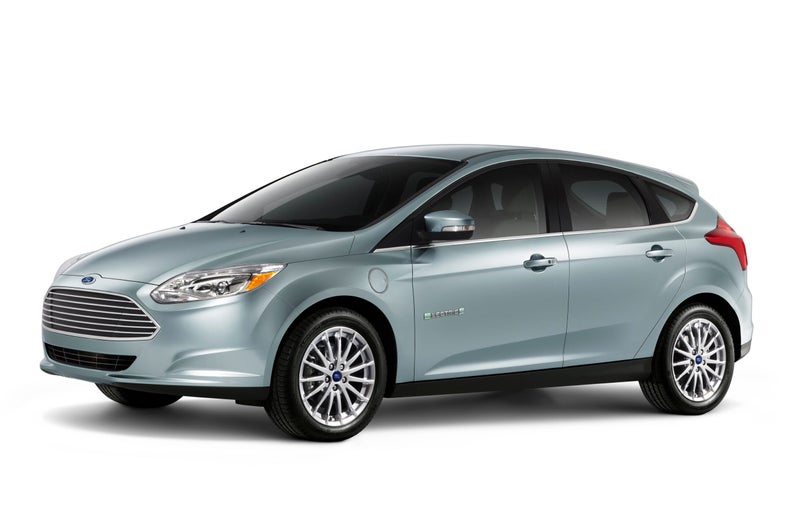
Focus Electric

We’ve heard it said that electric cars make driving like using an iPhone app. It’s not true, but Ford’s choice of venue for the reveal of the Ford Focus Electric—the Consumer Electronics Show—probably won’t help change that perception.

The Ford Focus EV is part of Ford’s overall electrification scheme, which involves rolling out five distinct electrified models (ranging from the purely electric Focus EV to an plug-in hybrid whose details have not yet been officially announced) by 2013. The Focus Electric, which is schedule to enter 19 markets by the end of this year, is a five-door hatchback powered by a 23 kilowatt-hour, liquid-cooled lithium-ion battery. As with the Chevy Volt, the battery supplier is LG Chem. The Focus Electric will have a top speed of 84 mph and should reach a driving range comparable to that of its closest competitor, the Nissan Leaf, which gets approximately 100 miles on a charge. We don’t yet know how much the car costs, whether it will be leased, sold, or both, or how many cars Ford plans to make. We do know that it will be built at Ford’s Michigan Assembly Plant, on the same production line as gas-powered Focuses—an arrangement that Ford says will allow it to adjust production volume to demand.

We’ve known about the Focus EV for quite a while, and in fact Ford has been giving journalists short test drives in hacked-up demo models for at least a year. Today’s two real pieces of news involve the charging time and the mobile smartphone control system.

First, the charging: Because the Focus Electric uses a 6.6kW onboard charger, it will be able to charge in about half the time of the Nissan Leaf—in three to four hours from a 240-volt docking station. (By contrast, the Leaf uses a 3.3 kW charger; we suspect Ford can get away with the faster charging because their battery, unlike Nissans, is liquid-cooled, so that the battery temperature can be carefully controlled during charging.)

Next, MyFord Touch mobile. This smart phone app will let you check the car’s state of charge, program its charging time, heat or cool the cabin remotely, find the car using GPS, and control various other functions. (The Chevy Volt and the Nissan Leaf can both be controlled using similar apps.)

Expect more Ford news on Monday, the first press day of the North American International Auto Show in Detroit.

Want to keep track of the latest concept cars, automotive innovations, and more? Subscribe to Popular Science today, for less than $1 per issue!

6 Comments

Sounds interesting from a Leaf competitor's standpoint. However it all boils down to ergonomics such as interior luggage space for hauling things, cup holders, nooks and crannies to store thing which from the pictures online there are almost no storage spaces of any kind.

That is kind of insane to have such small storage spaces in this day and age!

The center console seems positioned too far back to be useful while driving. The shifter takes up so much room there is nothing available except the 'way too far away' glove box so good luck toting along your ipad, iphone, hearing aids e/remotes, your bubble gum, etc.

It looks there is no rear trunk space at all as the battery is far fatter than the other makers of EV's including one under the seat and behind it almost all the way to the top of the seat.

The front grill is a bit awkward but the rear looks very Lexus like and nice. Overall it's a pleasing looking car on par with the Leaf but it won't really standout from the crowd and I suspect most EV owners want something that stands out from the pack and neither the Volt nor the Focus do that.

Typical Detroit to make cookie cutter cars.

The charging speed IS a factor however as the LEAF charges too slowly to be practical (7 to 8 hours with 220V, over 12-16 hours with 110).

Price will be the driving factor probably however and I bet this Focus will come in almost $40K. Any bets?

I've read news at ford that they are targeting 22.5k to 28k. with the 7500 rebate from the government, almost as cheap as a normal car. So even if all you say is true (you sound like a nissan plant (maybe a leaf)) then I doubt others will be able to compete with the Focus EV.

Only a cloistered marketing agent would think that cup holder placement, ,luggage and amenities is the priority that consumers want!

It is possible to create a 90 mpg highway car for under 10 grand right now. I'm not talking those flimsy solar cars or even electric hybrid, i mean lean burn four seat gasoline combustion engine. Only car companies think a car that looks like this won't sell:
www.aerocivic.com/imgs/profile-z.jpg

Design a new kind of cross country touring car. 90mpg highway. California to Massachusetts on 2 tanks of gas and see how it would dominate the market. College kids wanting to see America, work commuters.

A boat tail on that car would give it 15% better fuel economy. But it's not there cause it's unsightly for consumers? Side wheel skirts, aerodynamic grill, flat under pan. These are basic concepts that would make a car designed for it's role as a conveyance of people not 2,000 pounds of metal. You can make an averaged size car much lighter using carbon fiber and MUCH more safer. Carbon fiber hard to manufacturer? Make just the hood carbon fiber. That's 130 pounds saved just in the metal hood i know that car has!

Somehow small light cars are categorized as unsafe, or un-roomy, but that is simply not true. What people want right now is the Model T of efficiency. The first car to get 100mpg highway will be THAT car and make all cars before it obsolete. It will have buyer ques twice as long as when the Prius fist came out. That company that makes it will be rich. It is possible to do that today or better with existing technology for under 18-20 thousand.

I ask why are we unwilling?

Nice. If my calculations are correct, when this baby hits eighty-eight miles per hour... you're gonna see some serious sh1t.

I am an American who wants to buy an EV ASAP but as of now nothing can be purchased in Colorado save the expressly unaffordable Tesla (> $100,000 is NOT affordable to 98% of Americans).

Do note that Nissan has chosen to avoid those cold weather markets like Colorado probably because they know the range might be less than 50 miles in such places which speaks volumes about whether these EV's will be practical or not.

In Ford's defense I am surprised and happy that Ford is including Denver in one of the initial release markets that says a lot about American businesses for Americans and Nissan is for Nissan stockholders in Japan who could care less about 'fairness'. Only their image.

Hopefully the Ford Focus EV will be priced under $35,000 and with the rebate that might work for many Americans but any more won't as it would just make more sense to keep buying the Toyota Prius at around $22,000 instead of paying $27,500 after rebates for a full EV with limited range.

The price point Nissan ($32,850) has priced their EV at is a break even price point where people can seriously consider an EV versus a hybrid or a straight gas economy car. Even then it's a stretch due to the limited range in bad weather.

Hopefully the Honda Fit EV will be under $30K and the Toyota RAV 4 made by Tesla will be under $35K and then there will be more serious competition for EV considerations.

Is it just me or is the CMAX and Focus the same car?


June 2013: American Energy Independence

Five amazing, clean technologies that will set us free, in this month's energy-focused issue. Also: how to build a better bomb detector, the robotic toys that are raising your children, a human catapult, the world's smallest arcade, and much more.


Online Content Director: Suzanne LaBarre | Email
Senior Editor: Paul Adams | Email
Associate Editor: Dan Nosowitz | Email
Assistant Editor: Colin Lecher | Email
Assistant Editor: Rose Pastore | Email

Contributing Writers:

Kelsey D. Atherton | Email
Francie Diep | Email
Shaunacy Ferro | Email

circ-top-header.gif
circ-cover.gif