An enzyme found in soybeans could turn an ingredient in vehicle exhaust into new usable fuel, according to a new study. It's a major step on the path toward making fuel out of thin air.
Scientists were working with a microbe called Azotobacter vinelandii, which is found around the roots of various food plants. It creates an enzyme called vanadium nitrogenase, which produces ammonia from nitrogen.
In a study published in the journal Science, researchers took away the nitrogen and fed it carbon monoxide instead. The enzyme started making short carbon chains, two or three atoms long -- in other words, propane, which fuels the blue flames of camping grills across America.
Markus Ribbe, a scientist at the University of California-Irvine, says in a new paper that the enzyme could be further tweaked to make longer carbon chains than those that make up propane. Ribbe thinks he can modify it enough to produce gasoline, Discovery News reports.If it's perfected, the technique could lead to cars partially powered by their own fumes or by the air around them.
Scientists who were not involved in the research hailed it as a profound discovery, according to Discovery News. Much more work needs to be done, however. Ribbe says it's very difficult to extract the enzyme, and it has only recently become possible to produce it in large quantities.
Five amazing, clean technologies that will set us free, in this month's energy-focused issue. Also: how to build a better bomb detector, the robotic toys that are raising your children, a human catapult, the world's smallest arcade, and much more.


Online Content Director: Suzanne LaBarre | Email
Senior Editor: Paul Adams | Email
Associate Editor: Dan Nosowitz | Email
Assistant Editor: Colin Lecher | Email
Assistant Editor: Rose Pastore | Email
Contributing Writers:
Rebecca Boyle | Email
Kelsey D. Atherton | Email
Francie Diep | Email
Shaunacy Ferro | Email
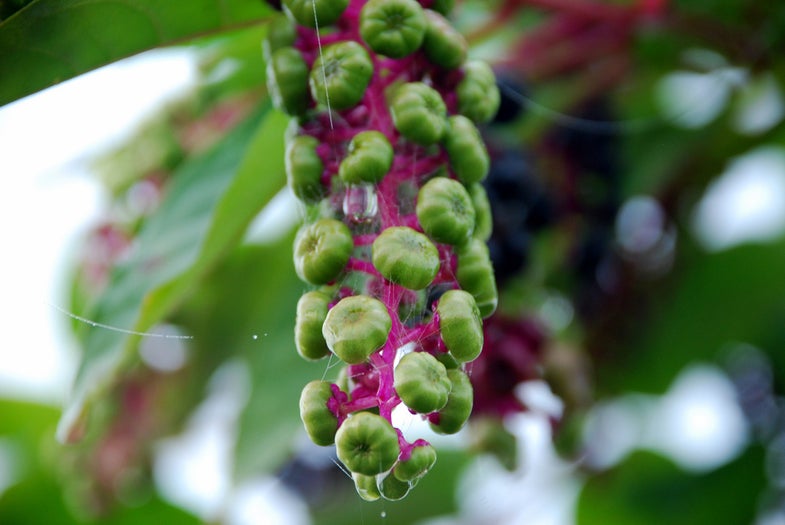
This is an interesting discovery. I'm curious to see if anything comes of it. Oh, by the way, the image you have attached is of poke berries, not soy beans...not that it really matters.
That's not a picture of a soybean plant.
Beat you to it GregNJ. ;-)
A balanced combustion reaction in a car does not product carbon monoxide. This is what Catalytic converters were for. They are filled with Platinum Dioxide and would react with CO to product Platinum carbonate and O2.
Manannan suggests Platinum is no longer a catalyst but directly part of the reaction? Not!
I'm no chemist but 2(CO) + O2 --Pt--> 2(CO2)
NOT this : 2(CO) + Pt ---> PtC2 + O2
@OddNotion
Maybe somebody made Poke Berries out of soy products =)
@OddNotion - Unfortunately, my ADD only allows me to read the first sentence. ;)
The article referred in the link does an excellent job of explaining exactly how they get this organism to produce propane.
Interesting discovery...!
The plant pictured above this article is Phytolacca americana, or poke sallet. Very poor people in the southern states used to eat it, but don't much now as it is toxic if you don't prepare it correctly. I let poke grow in my garden because I enjoy the way it looks, and because it always makes older people in my family happy to see the plant. Birds also enjoy the berries. Not sure why someone mistook this for soybean.
"Poke Sallet Annie, gators got your granny..."
I couldn't believe it when I saw this picture. I have been trying to identify these monsters with their inky berries for a long time. Someone once told me it was ginseng. I have a wildflower guide, I couldn't find it in there recently. So when I saw this and saw it was soybeans, well...I figured, "Wow! Purple Tofu." So I am glad the personage here pointed out what it really is. I have only heard of it through the quoted Joe South song from the 60s. And I thought it was 'poke salad', so thank you. Now I can read about it. although, if it ate carbon monoxide, I wouldn't mind the berry/ruined pants connection, from a surveyors point of view.
You don't get something for nothing. Where does the energy come from to join the molecules together? You can't just bond CO and get propane without energy coming from somewhere.
I love this site and magazine but they sometimes ignore the fine print in the articles. This is a great breakthrough but as the comment above me suggests, you don't get something for nothing and don't expect this to solve the energy crisis. The article mentions that the enzyme requires the hydrolysis of ATP to work, so an energy source is still required.
This discovery would still have many uses, such as converting energy from renewable sources into easily transported chemical sources of energy at remote locations. It could also produce building blocks for long hydrocarbon chains required to make plastics among other things.
umm those aren't soybeans they're unripe pokeberries