Next-generation cars are already being designed to keep us comfortable. But some car companies are going a step further, aiming to make us invincible inside our cars.
By 2020, "nobody shall be seriously injured or killed in a new Volvo," according to the carmaker's Vision 2020 program. Volvo and other automakers are hoping a confluence of technology will make cars safer and potentially fatality-free, Computer World reports.
Some of the technology already exists, such as sensing capabilities that let cars park themselves.
As part of its Vision 2020 program, Volvo will start testing "road trains" early next year, in which cars will use adaptive cruise controls to maintain a set distance from each other. Road trains will take advantage of existing automated systems for maintaining distance, accelerating and decelerating, according to Volvo.
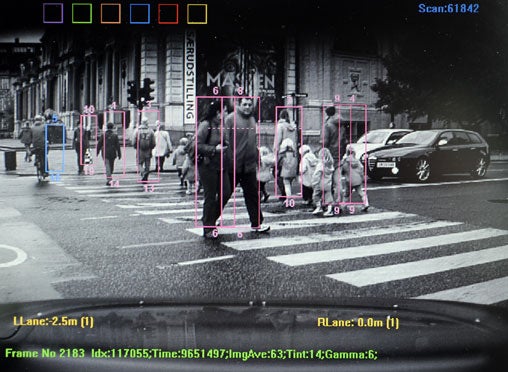
The 2011 Volvo S60 has a passenger-detection system that combines radar with a camera to measure the distance and trajectory of moving objects. If a person steps in front of the car, the car will bleep to warn the driver. If the driver doesn't react immediately, the system automatically applies the brakes. The system can prevent pedestrian collisions at speeds up to 20 mph, and at higher speeds, at least the car's speed is reduced before impact, Volvo says.Making cars truly fatality-free involves a new technological infrastructure that can support advanced crash-testing, as well as car-to-car communication, Computer World reports.
Cars of the future will not only be built to keep us safe, but they will actively search for dangers by communicating with other cars and with smart road infrastructure, including signs, traffic lights and parking lots.
That will require a dedicated wireless spectrum as well as agreement about standards among auto brands, meaning this type of system is several years away. But passenger radar and road trains are a start.
138 years of Popular Science at your fingertips.
Each issue has been completely reimagined for your iPad. See our amazing new vision for magazines that goes far beyond the printed page
Stay up to date on the latest news of the future of science and technology from your iPhone or Android phone with full articles, images and offline viewing
Featuring every article from the magazine and website, plus links from around the Web. Also see our PopSci DIY feed
Science is reinventing play, from extreme sports to gamification to ridiculous roller coasters to the playgrounds of tomorrow, and this issue is chock full of fun. Also, on a less fun note: Did global warming destroy my hometown?
I guarantee if you get clobbered by an 80,000 lb semi truck that your not going to survive in a Volvo or even a Tank. Get real this is such trashy boasting. It's a good goal but it's all about bragging rights and Volvo should be disciplined!
Ditto if you get clobbered by a train.
@gizmowiz "Volvo should be disciplined!" - really?? Sure, no vehicle will ever be 100% fatality free, but props to volvo dedicating themselves to what auto makers should always be working towards. anyways, I'd hate to be your kid - be holed up in a room for weeks just for boasting that I got an A on a report card.
I'm happy about the fact that car manufacturers are striving to create less injury and fatality. I don't think we really have the technology yet to make something that would work as well as they say it will at this time, though. They're saying 2020 so - we'll just have to see how far they go with this.
I think the point is that your car will react to these things, such as a train and truck, and act to preserve the driver's life. Which the article points out, will take a lot of infrastructure to develop the myriad of sensors required on just about all road hazards, and ones that might not even be considered at the moment, such as cyclists.
If I just looked at the picture and didn't read the article, this is what I'd guess Volvo's grand statement would be. "All cars shall apply a point system to intended pedestrian targets." I think this could be a new direction for Volvo.
The point of this is not to make the vehicle able to take the impact but to avoid the impact completely
giz you're right on - you can put all the bells and whistles you want in a car but unless you take away the human error for every person and vehicle on the road, there's always a chance that somebody might get killed. Too bad that even with human error eliminated, companies like Toyota screw up enough to make up for it so even with all this extra safety crap, you still have a chance of getting blindsided by an out of control prius and knocked in front of other traffic, off a cliff, etc... I don't know about disciplining, but to claim that by 2020 is just outrageous.
I hear by 2030 Volvo is going to make the drivers seat a toilet so you feel like you never have to leave your car...(another outrageous claim that I'm sure one of these wacky car companies will make in the near future)
from Ojai, California
I have a 15 year-ish old car. It has sensors to make an annoying beeping sound whenever the key is in the ignition and a door is registered to be open. The sensor is broken and the annoying beeping goes off at random whenever the car is on. If I can't even turn off the thing that makes annoying beeping sounds, I don't want a more complex and more easily breakable device that will either render the entire car inoperable or smash me into a wall.
Cool technology but it's sad that it has to come to this. It takes all the fun out of driving. There's just too many stupid people behind the wheels of cars these days.
"I hear by 2030 Volvo is going to make the drivers seat a toilet so you feel like you never have to leave your car.."
Old news. Audi & Chrylser are already in development of a car to compete with this. Chrysler is rolling out an updated version of it's 1980's "K" car series called the "P" car. Not to be left behind, Audi is countering with the "Outhousen 2000".
suppose that means i can drive a little faster when i make my millions someday? =)
My wife suggests naming it the Volvo Titanic.
As an attorney, I take personal offense at this attempt to destroy my means of livelihood :)
The most dangerous part of the driving experience is the drivers themselves. Driving is one of the most dangerous activities a person does on a daily basis. Sure it isnt as much fun but then again we make seat belts and air bags, they arnt fun but they do save lives.
I find that horrible that ppl even bash Volvo. They were the first to invent most of the stuff that keep you safe in a car ie seat belts, ever heard of that... They mite aim early for such a goal but at least they are willing to take the steps toward better driving conditions. They are some of the most reliable cars out there and i think that augmented reality and electronic communication between cars is the future of it even if were not ready for it now. @gizmowiz It's not about building an indestructable car lol, its about avoiding the truck completely, im sorry you didn't see that. anyways thumbs up volvo!
Take the human driver out of the equation and many lives will be saved, there will be less congestion, and we'll all be better off.
Nobody cares if you will miss the "fun" of driving. If you want to have fun driving a car, go to a track. If you want to get to where you are going, let the car get you there.
gizmowiz
08/06/10 at 12:12 pm
Wrote:
"I guarantee if you get clobbered by an 80,000 lb semi truck that your not going to survive in a Volvo or even a Tank. Get real this is such trashy boasting. It's a good goal but it's all about bragging rights and Volvo"
ScienceWriter Writes:
That semi-truck could be a Volvo truck (www.32chrome.com/cab_sl1.jpg), then maybe such a system is implemented onboard the truck as well. The purpose of such a system is not merely to protect the Volvo-car driver, but also pedestrians ... and truck drivers. A truck driver could potentially be heavily victimized, forced to pay exorbitant amount of dollars and even doing time in a US private prison. Not so nice ...
I watched a documentary about this idea years ago, all cars on the road communicating with eachother through some greater network allowing the system to protect it's drivers in any number of ways the most obvious being removing human error. Imagine vehicles being able to travel at nearly any speed safely...
Of course nothing is perfect and oncedrivers are removed from control who becomes responsible for the accidents that do happen? The car companies? They would never want that. The government (taxpayers)?
In theory an individual could still drive manually so long as the automated system ultimatly had the final say though I liked the idea presented in the documentary that the windshield could become a computer monitor during autopilot. I wish I remembered the name of that film..
Two things:
1) The cars we drive are not the problem. The problem is our lack of attentive, skilled, and well trained drivers. Our driver's education here in America is a joke. Countries like Germany have more relaxed driving laws (as illustrated by the absence of speed limits on the autobahn) and yet they have fewer driving-related fatalities every year. This is because the Germans ALSO have a far more intense driver's education program that equips their drivers with the ability to actually drive WELL. While technology can be awesome, I am tired of the innovations (and the legislation that typically accompany them) that allow the incompetent to remain so, while simultaneously restricting the responsible. Money would be better spent by properly training our drivers. And as a bonus, we could avoid yet another "improvement" that costs more, weighs more, and makes our cars ever fatter... anyone else notice how huge our cars are getting?
2) From a more absurd angle, I also saw a movie where cars were connected to a computer network that enabled the driver to sit back and relax while the car safely drove itself. It was called i-Robot. I'm pretty sure the computer took over the world and tried to kill everyone. Just sayin.
That computer had far more power than this network and was a movie. No one system will ever run the whole.
To your other points though, I do believe the autobAhn has a speed limit now. I know it didn't at first but later they implemented it for safety reason. Unless since then they have had another change of heart there should still be speed limits.
Do you know what the actual number difference is in fatal accidents i in germany? In theory this system could reduce those number to a vey small fraction (they claim 0 but ehh) I doubt germanys drivers could compete with those numbers.
I do understand where you are coming from though with individual responsibility buti think the benefits of increased free time and the ability to work on school work, office work, catch up on the news, plan your week whatever while the car drives you becomes a valuable tool in the future.
The cost os certainly the scariest part in my opinion, though paired with an idea like the solar panel road ways (if that pans out) could help a lot. As for size of vehicles there is absolutely no reason this tech should increase vehicle size except by maker preference.
Dam, this technology isn't going to work well. It will cost billions of more dollars and time before we actually get less fatalities.
Btw, governments are trying to promote mass transit, so we will see how many cars will be on the road.
http://motorcycleinsurancehq.com/
Sounds like a great idea. I'm surprised that the technology of using satellites to control vehicles and traffic hasn't been developed. Wouldn't it be nice to simply ride to your destination rather than drive. I do think Volvo is on the right path to help limit fatalities in collisions and unlike body shop owners, I look forward to the possibilities of a collision free world.
http://www.autoglasslocator.com
A laudable, though unattainable goal, at least to the 100% level. Human caused accidents may someday be eliminated, but acts of nature can not. Pretty much if a landslide like the Hillcrest AB slide buries your car under 100 metres dolomite rock boulders the size of houses, the car isn't going to be of much help to you. Even in an indestructible car, you would die of air/water shortage before they could get you out.
And never underestimate the ability of people to find new ways to put themselves in harms way.
Still, the pedestrian avoidance thing is doable and worth following up on. I can't see the "open-road" types in their sports car linking in to 'trains' anytime soon, but it would be a nice option to offer, especially to the distractible multi-tasker, or the impaired (fully automated to the door service), or the elderly traveller that tires quickly.
Why can't Volvo and other companies just make a car that obeys the speed limit? Should be cheap and easy with today's technology - GPS and electronic engine control. Do that first and save 10,000 lives, a million injuries, and 20 billion dollars a year of waste cause by lawlessness of ignoring speed limits in US. Do the driverless cars and science fiction stuff later.
thanks You sure do know what your'e talking about. Man, this blog is just great! I cant wait to read more of what youv'e got to say. Im really happy that I came across this when I did because I was really starting Tablet Android Honeycomb Terbaik Murah