Feature
Advanced electric drive, autonomous navigation and other technological advances will revolutionize the way we drive. PopSci presents stunning visions for the future of the automobile
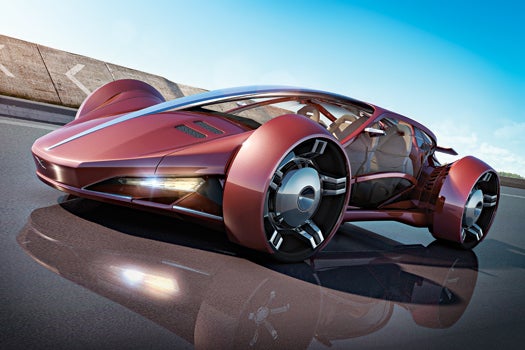
The Electric Luxury Racer Nick Kaloterakis and Bob Sauls

In this month's Future of the Car issue, we've envisioned three ambitious concepts for vehicles of the future, based on insights and other concepts from some of the brightest automotive designers and engineers in the industry. You can see the others here.

A zero-emissions car doesn’t have to sacrifice power or comfort. Advanced structural materials and in-wheel motors will make it possible to build ultralight, frighteningly fast luxury sports cars with seating for four—like a Porsche Panamera for a post-oil world.

Head-up Display
Replacing the traditional instrument cluster are semitransparent digital gauges for speed and battery life. Navigation-system guidance is also projected onto the windshield in front of the driver.

Ceramic Windows
The windows and transparent doors are made of aluminum oxynitride, a millimeters-thin ceramic being developed by the military as a bulletproof replacement for vehicle windows and domes.

Wheel Motors
As with today’s Audi E-tron concepts, four independent electric wheel motors, linked to the steering controls by drive-by-wire technology, reduce weight and supply full torque instantaneously.

Magnesium Exoskeleton
A magnesium external frame inspired by dune buggies and racecars provides a high strength-to-weight ratio.

Energy Storage
Lithium-ion batteries line the vehicle floor, further freeing up cabin space. A graphene-based ultracapacitor—a device currently being developed in university labs, which uses sheets of carbon only one atom thick to store twice as much electricity as today’s capacitors—offers immediate bursts of power.

Want to keep track of the latest concept cars, automotive innovations, and more? Subscribe to Popular Science today, for less than $1 per issue!

17 Comments

That's pretty cool, but I am wondering if you guys can stop calling electric cars "zero emissions," those batteries get charged by electricity made from [generally] coal power plants.

are those plastic / metal tires ? Ride might be a bit bumpy & harsh !

that car looks sick. and freddy, by time anything as cool as that car comes out, i would seriously hope we have gone all nuclear and power is emission free. Wishful thinking though.

It's true, by the time this car would ever hit the market, the renewable/nuclear market will hopefully have expanded considerably.

mikefigiel, if you look closely the red part is not the tire itself, it only covers the tire. The part that actually touches the road looks like rubber.

No, they are zero-emissions... =/ how we harness power is a separate issue that can still be addressed. The power generated from the ocean's tides, current, solar, wind, etc. Nuclear is even an efficient option, granted we find an easy and safe method for disposing its waste.

On a style note, it looks lame. I'm all for a new look but please, with a little taste. It's a bit reminiscent that one car that kinda looks like a PT Cruiser but with the wheels separated from the main frame like this one. Yuck. Put the wheels into the body of the car and if it looked a little less like a wedge that would be a plus. Looks like a wooden derby car.

oh come on..a wooden derby car?! Personally I think it looks great, I wouldn't kick it out of my driveway, that's for sure.

I just wish that they would make these cars look normal. If you were unable to tell the difference between one of these cars and your regular gas powered car, then more people would be open to the idea of owning one. People are naturally resilient to change.

I always wonder when I see cars like this and the new GM EN-V Robotic pod thing do they live in the real world?
I live in central Texas in June, July and August it gets to be around 104 to 106 degrees and when it’s that hot and you have even a sun ruff it turns you car in to a popcorn popper on wheels, I have come out to my car at 4:00 PM to leave to go home and found the outside temperature is 105 and the inside of my car is 130 to 136 degrees I would not set foot in an all glass toped car if you gave it to me and told me you would pay me $500 per month to drive the thing.

My point is do electric cars have air conditioning?

The reason these cars look so different is that they are not limited by the restrictions imposed by the current fossil fuel technology. People are not that resilient to change, or we wouldn't have computers, tv, hot water, etc. People can recognize an improvement when they see it, have some faith.

This looks so awesome!!!!!

freddyjones39:
.
Nitwit! Would you rather have emissions generated just feet from you where they are highly concentrated and most chemically active, and where extremely limited space and weight penalties for catalytic converters and smog hardware make controlling such emissions a major challenge? Do you prefer the emissions of thousands of vehicles to be in as close proximity to your lungs as possible, to maximize their potential for harm? Would you rather generate your toxins dozens of miles away, where you have the luxury of sufficient space and heavy hardware for anything you need to abate such emissions?!

You want to score points by splitting hairs... what would you prefer? ICE cars that are so monstrously inefficient that even in a worst-case scenario, they produce many times more smog than a silent, powerful, ultra simple (one moving part), super-efficient electric vehicle? EVs CAN be entirely zero-emission, unlike any ICE car ever built-- many EVs are charged by solar panels on the roofs of the homes where they are parked... as photovoltaic panels become more affordable, you'll be seeing more and more of them. I can run my EV on electrons I harvest on my roof-- can you say that about your gasoline car?!

You are desperate to criticize EVs in any lame, pathetic manner you can because EVs represent change, and change obviously terrifies you-- what are the alternatives? To continue to use ICEs, running on rapidly dwindling oil reserves? China and India consumed virtually no gasoline until very recently-- they were third world countries, but no longer: they are rapidly industrializing and their citizens want to drive cars like the rest of the world-- how long do you think oil reserves will last when they do? What do you think that many more ICE vehicles will do to worldwide air quality? There are more people in China and India than all the rest of the industrialized world combined, and they will no longer be content with riding bicycles-- obviously, you don't bother to consider such factors!

What possible point do hope to make with such a statement? I have no patience for numskulls such as yourself that criticize EVs for being imperfect, when you offer no better solutions!

all these futuristic concept cars are nice and all, but what id really like to see are converter kits so you can turn your existing gas hog into an ultra-efficient zero-emission electric car. i love my '94 full-size blazer with its 350 v-8. i want an electric converter kit that can let me keep my old ride and its familiar comforts. the easiest way would probably be an entire chassis replacement that holds all the electronics and batteries; all id have to do is keep the body and just drop it on.

@mikefigiel

There is a metal/carbonfiber (maybe plastic) hub over the tires that nearly hits the ground, look close at the picture and you will see it is actually sitting on tires.

I have a problem with wheel motors. I have seen you praise them on this prototype and in several other articles about electric drive cars. WHAT ABOUT "UNSPRUNG WEIGHT?" I remember in most of my performance/race reading, a big enemy of good handling is unsprung weight: wheels and suspension pieces that must go up and down as the road does.
Enertia, momentum, and gyroscopic effect cause heavier wheels, tires, axles, etc to make the vehicle (car, motorcycle) track or handle poorly. Thus the holy grail (sic) was to find rotor, tire, rims (wheels) that are light as possible yet strong enough to withstand road irregularities, bumps, dips, potholes, etc. I think that is why specialty wheels like "Centerline" became important. It wasn't their looks that racers sought, it was their light strenght (achieved mostly through minimum metal and lightweight material (magnesium, aluminum, etc). Besides lightening the overall vehicle, there is less gyroscopic effect (quicker turning), less enertia (quicker accelerating), more continuous contact with the road (better absolute handling). An extreme example is a 30 pound wheelset vs. a 15 pound wheelset. That lighter one would navigate a course easier/faster. (less stress on the shocks and springs).
I know I am not telling you something you don't know. Just tell me how a motor in a wheel hub has any benefit besides reducing frictional losses?

The seeker of knowledge who seeks to reach beyond the stars to go where no mans gone before to see things no man has seen and bring these experiences back for the whole world to hear and see.

it's just a concept but i like it if the car was on the market and i had the money ill go electric for this car.good job drawer i think this is a work of art and should be treated with respect it's not bad design and has good implications for the mane stream.

I can't wait for the future... that car looks dope.

Lola

Would You Rather

@billdale

'Chillax' dude! I don't think he meant to criticize the development. Just the fact that we have a widespread ecologically unfriendly way of generating massive amounts of electricity for power grids.

Yes, the future holds alternatives for power generation that aren't as harmful to the ecosystem. But, for right now technological shortfalls and political and corporate maneuvering hold these options away from reality.

The statement made was a full picture concept. An electric car alone (not a hybrid) would be zero emission operable. However, coal burning or nuclear power plants generate emissions that are not ecologically friendly.

As far as change is concerned, the majority of the human race is initially resilient to change because it's viewed as unecessary when things seem to be going generally well. Anything that threatens serene balance must be handled discretely. This is why electric vehicles have not flourished in the past (oil companies were doing well and this would threaten their serene balance; especially with a product bearing zero demand).

Now that the majority of the world looks to technologies that will help preserve it, such technologies will hold firmer ground and will eventually see the light of day with time. People have to want the change to come for it to happen. We'd be colonizing space right now, let alone have made it to Mars a decade or two ago, if the majority of people desired to do so.


June 2013: American Energy Independence

Five amazing, clean technologies that will set us free, in this month's energy-focused issue. Also: how to build a better bomb detector, the robotic toys that are raising your children, a human catapult, the world's smallest arcade, and much more.


Online Content Director: Suzanne LaBarre | Email
Senior Editor: Paul Adams | Email
Associate Editor: Dan Nosowitz | Email
Assistant Editor: Colin Lecher | Email
Assistant Editor: Rose Pastore | Email

Contributing Writers:

Kelsey D. Atherton | Email
Francie Diep | Email
Shaunacy Ferro | Email

circ-top-header.gif
circ-cover.gif
bmxmag-ps