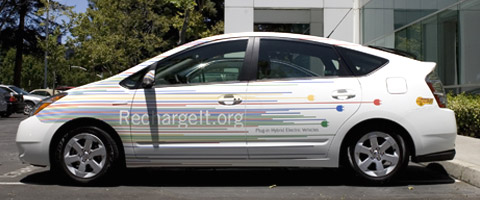
Imagine millions of plug-in vehicle owners returning home from work on a hot summer day, plugging in their cars at the same time, and melting down an overtaxed, outdated, and otherwise atrophied electrical grid. But the geniuses at Google say averting a disaster scenario could be as simple as a few lines of code (well, a few more than just a few). Working with a test fleet of a plug-in vehicles, part of a project the company initiated two years ago, Google came up with new "smart charging" software that can manage the charging needs of EVs based on real-time signal data from a grid operator. For example, automatically turning off EV charging during times of peak grid demand.
The software is in its early stages, but since 2007, when the RechargeIT plug-in hybrid fleet program began at Google's Mountain View, California headquarters the company has pursued a number of solutions, like plugging vehicles in when parked to give the grid a series of battery backups and reduce strain.
The company's director of Climate Change and Energy Initiatives (yes, that's a real title) says the possibility of a large number of plug-in vehicles hooked to the grid presents an opportunity to introduce a megawatt-scale storage technology in the grid for the first time.
The incredible innovations, like drone swarms and perpetual flight, bringing aviation into the world of tomorrow. Plus: today's greatest sci-fi writers predict the future, the science behind the summer's biggest blockbusters, a Doctor Who-themed DIY 'bot, the organs you can do without, and much more.


Online Content Director: Suzanne LaBarre | Email
Senior Editor: Paul Adams | Email
Associate Editor: Dan Nosowitz | Email
Assistant Editor: Colin Lecher | Email
Assistant Editor: Rose Pastore | Email
Contributing Writers:
Kelsey D. Atherton | Email
Francie Diep | Email
Shaunacy Ferro | Email
So, I run on charge all day. Plug in my hybrid, so I can be on charge to church tonight and not have to burn any gas today. Three hours later, I go to church and BAM! I'm burning gas, because my stupid smart car wouldn't charge between 4 and 7!
Obviously, my next stop is to have that little "smart grid" thing modified or removed.
Even worse, I get in my electric car, and it is half charged because this thing has been feeding power to my neighbors all afternoon! I know I'm getting refunded for the power out, but the charging station down the street cost more than my wall socket, so I'm being ripped off (in either milage or money).
You cannot expect the private consumer to shell out large amounts of money for green tech and then burden them in its application. If there was a gas shortage would you let the government, or worse yet, the oil companies come and pump your tank dry? Even if they promised to come and refill it at night? I don't think so.
If the power company can't meet demand or keep the grid stable, then they need to take some of their profits and build the necessary generation capability and infrastructure to offer a better product. I am aware that we would end up with slightly higher power costs, but that is the way a free market works.
We do need to be concerned with millions of EVs being connected to the grid-- not because they'll CRASH the grid, but because they'll help KEEP THE GRID FROM CRASHING if they're NOT connected.
"V2G", or "Vehicle to Grid", has been around for several years now, and being adopted by many utilities and municipalities as a blackout prevention tactic. Google V2G to see more on this.
Generating stations are vulnerable in ways, so that to be able to generate enough power during the daytime, the generators must be running at close to full power at night, wasting much of the energy they make. When EVs are plugged into the grid at night, they are using that otherwise wasted power. And when EVs have interactive, intelligent connections to the power stations, they can sell some of that power back to the grid at a fair profit when there is a danger of a blackout, such as on hot summer days when too many customers are trying to use air conditioning.
EVs tend not to be problem loads to the grid, anyway, since they usually get their power at night, and because EV drivers tend to be the same people that install solar panels on their roofs.
I attended the annual Santa Monica Alt (alternative) Car Expo last weekend. It's a popular event, and this year I got to drive BMW's Mini- E, which is very well-designed and powerful.
There were nearly as many booths selling solar panels at the Expo as there were showing off new EVs-- if they're as successful as I expect, grid load will dramatically decrease rather than increase. Many state and federal bodies are subsidizing installation of PV panels on homes, apartment buildings, offices and factories, and such panels are bound to become more common as thin-film panel technology matures, increasing their efficiency and driving down prices.
I am grateful for the development of the Internet, because without it, we would never be able to share information as we do on Popular Science's website.
Oakspar-- you're too often only willing to see the problems and not the solutions, often complaining about stuff that if you checked, you'd find is not a problem in the first place.
If you did your homework, you'd know that these are INTELLIGENT systems that don't blindly drain your EV's batteries to the point that you can't drive it-- you have control-- you decide if and when you're willing to sell power back to the grid, and when you do, it's not like table scraps-- the power companies know that by being willing to pay well on rare occasions to borrow some energy from EV owners, they can avoid billions of dollars on more power generating stations that will not be needed except on rare occasions. If a metropolis such as Los Angeles has a threat of blackouts 10 times in one year that can be averted so easily, and then it goes years more without such an emergency, the wisdom of V2G is obvious: we don't need more monstrously expensive generating stations that waste energy and resources, we just need intelligent management of the resources we do have.
V2G and RechargeIT are controlled by the car owners, not the grid. Such blackout problems typically do not last long... an hour or so... so that spread among lots of EVs, the energy supplied is not much from any one car.
You're right-- the free market should control such things, and this is the free market at work.
Next time, check the facts before you start belly-aching.
Consider this scenario: when you come back home in the afternoon you charge your car from the solar or wind energy accumulated during the day by your home electrical system. During hot sunny days or windy days the extra electricity can be sold to the electrical company that can keep it on the grid or extract it from the grid and store it in the form of potential energy for future peak use ( there are special hydro-electrical accumulation power plants that do just this ) . This scenario is very easy on both the consumer and the electrical company and places the complexity on the electrical company and not the consumer.
Lets add electric "on demand water heaters" to the equation so that "green energy savers" raise the peak demand to the morning shower time. The intelligent systems would attempt to drain your EV to limit line load. Your "intelligent" system would attempt to discharge your DC batteries, run it though your not so efficient inverter then supply the 240 VAC to your resistor bank "on demand water" heater.
If everybody used their own inveter, system line harmonics would be horrible, but inverter switching efficiencies would be even worse.
Most utilities like the idea of a smart grid as a means for fancy rationing. Nominal load shifting means shutting off your power so they can supply "vital" loads. You are not a vital load.
Like it or not, there will be some sort of power priority system. The 'electric car will save the environment' ignores the impact that large scale usage will have on the electric power infrastructure. Plug in vehicles will produce an immense load on the system. Maybe they can aid in load balancing -- but not if they are charged willy nilly. (Oh, and studies show that they will frequently be charged during the day).
There are already interrupted systems in use. Around here, you can get cheaper rates for electricity used in heating and A/C -- if you agree to the interruptable meter. You get one or more remotely controlled meters to power these systems. They will shut off -- within defined parameters --during high usage periods.
Why does the oppisition to this idea assume that the users will act as unknowing apes. Most of the people who buy prius's are environmentally aware individuals. If they know that charging their car during peak ours is bad for the environment(extra capacity added to grid), they will wait to charge it at night. I believe that people's ability to act unselfishly has been proven by the large green movement going on right now. We just need to be educated. Like Billsdale said "Such blackout problems typically do not last long... an hour or so... so that spread among lots of EVs, the energy supplied is not much from any one car.
If 1 plug-in-prius owner has to go to church at night requiring a charge in the afternoon it is not a big deal.
Good comments doug. Education is a key. There are many uninformed comments above yours.
V2G may help. It's a long way off and there may be better ways that don't use up the life of your battery. On thought, when those hybrid batteries start to fail to get you to work, sell them to the utility or put them in your basement to make money by buying cheap power at night and selling it back to the utility in the afternoon.
The problem is not as simple as (having that little "smart grid" thing modified or removed). If you notice, you and your 4 or 5 neighbors share a transformer. At peak load, there is probably something like 10-30% extra capacity. Your homes may use 50KW and you may have 55 to 65KW of capacity. A plug in vehicle can use 6KW. One may push you and youe neighbors over the edge, if not one then 3. If eventually you have 8 or 9 electric vehicles on that transformer, neighborly cooperation would be better than sitting powerless while the power company fixes the transformer fuse that "oakspar blew out again".
In the past, electricity was a pretty simple thing, whether you're talking about generating stations, the grid, our appliances, or radios and flashlights. As time goes on, everything about electricity will be much more complex-- expect that part of the solution of future power will be a process of the best solutions surviving and flourishing, and promising ideas with hidden flaws will fade away. As things shake out, there will still be a grid, but I expect it to be supplemented in large measure by lots of solar and wind-- in urban areas, solar will be ubiquitous, with panels on nearly everything.
Single-family homes, garages, apartment buildings, office buildings and factories will all be generating power, and with nanodots and other new tools to make solar more and more efficient, we won't be thinking of the grid as our prime source of power, it will become little more than a backup. Wind power may become the power source of choice for rural use.
Urban and suburban EV charging stations will be receiving the bulk of their energy from the roofs of local businesses and residences, and decentralized charge reservoirs, especially in homes and public EV stations, will make blackouts and power shortages far less likely. Charging will be available wherever you park-- the supermarket, school, theater, church-- so moving about in our lives will be more convenient and affordable than it's ever been.
simple solution would be to use a household energy storing battery system which could also be used for other peak energy users like a/c and water heating
This appears to be another longer term problem occurring with our fuel consumption, in this case electricity. Perhaps our manufacturers should be seeking alternative sustainable fuel that assists in the running of the hybrid so it self charges when driving. If electricity charged vehicles will require limits to their charging times the sales will reduce and manufacturing will again lose market share. The comments are correct! I do not imagine I would want restrictions on when I can charge my vehicle and be limited in the use of electric mode!
Vincent
www.mycarforum.com
Agree with one of the posters above on self-charging cars. Why switch the dependency of one fuel to another? We'll just end up chasing our own tails. Also, to keep on topic, what if you are driving such cars from country to country? Hopefully only one type of 'universal' plug or adapter is used.
Lucy
www.ajaxcarhire.co.uk
Oakspar77777, I don't think you have to worry about not having enough power to get to church in the evening. Google could look at the calendar information in your Android phone, to see you need the car in the evening, match the appointment with the address or GPS entry in your phone, and use Maps to decide you need an extra 8 minutes of charging to cover the distance. Then it will co-ordinate with the other Google-enabled devices in the area to get you those extra 8 minutes.
Of course, none of this personal information will be retained, and your travel locations won't be logged, except for statistical purposes, measuring fuel economy, and road traffic management... right??
Lets add electric "on demand water heaters" to the equation so that "green energy savers" raise the peak demand to the morning shower time. The intelligent systems would attempt to drain your EV to limit line load. Your "intelligent" system would attempt to discharge your DC batteries, run it though your not so efficient inverter then supply the 240 VAC to your resistor bank "on demand water" heater.
www.promdresspicture.com
If everybody used their own inveter, system line harmonics would be horrible, but inverter switching efficiencies would be even worse.
Most utilities like the idea of a smart grid as a means for fancy rationing. Nominal load shifting means shutting off your power so they can supply "vital" loads. You are not a vital load.
solution simple serait d'utiliser une énergie domestique batterie système de stockage qui pourrait également être utilisé pour d'autres utilisateurs d'énergie de pointe comme un c / et de l'eau de chauffage
www.autonewstoday.net
Sovitaan yksi julisteita edellä itse panostusvaunujen. Miksi vaihtaa riippuvuus yhdestä polttoaineesta toiseen? Me vain lopulta jahtaa omaa häntäänsä. Lisäksi pitää aiheeseen, entä jos ajat tällaisia autoja maasta toiseen? Toivottavasti vain yhdenlaista "yleinen" plug tai sovittimen.
www.CARS-WEB.ORG
www.CARZ-INFO.COM
www.freshcarnews.org
www.thaicarnews.com