MIT Researchers say carbon nanotubes could provide a more durable, reliable energy-storage alternative to traditional batteries. And best of all, no leakage to speak of.
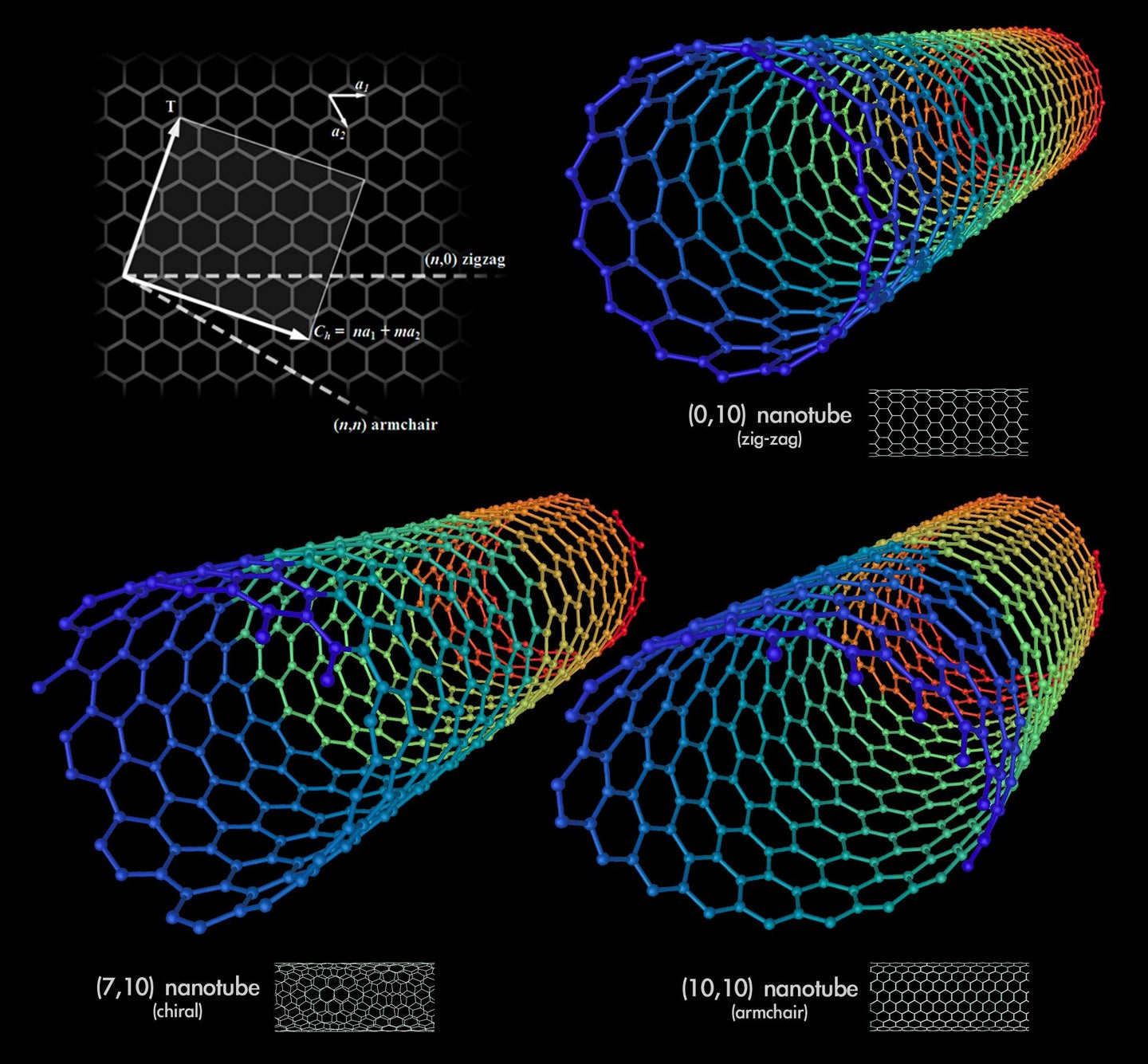
Carbon Nanotube Springs Could Provide Reliable, Long-Term Energy Storage, MIT Researchers Say Powering an electric SUV of the future? MIT researchers say carbon nanotubes, tube-shaped molecules of pure carbon, could one day provide reliable, robust long-term energy storage. As much energy storage, pound for pound, as a lithium-ion battery, only with little chance of leaking energy and a potentially infinite charge-recharge cycle. MIT

It's one of the simplest energy-storage devices known to man: The spring. Think of how a jack-in-the-box keeps hold of the mechanical energy it takes to compress that clown into the box, releasing it only when the weasel song reaches its climax. And that energy storage is a long-term proposition. The clown could likely sit, poised in that box in grandma's attic for 100 years, until some joker comes along, cranks the handle and, POP! Now imagine millions of carbon nanotubes -- tube-shaped molecules of pure carbon -- all storing as much energy, pound-for-pound as a comparable lithium-ion battery, then releasing that energy to give power to a lunar rover, a silent leaf blower or even a car.

That's the subject of two papers on the findings of Carol Livermore, associate professor of mechanical engineering at MIT. As part of the research, Livermore presents a theoretical electric power source, which stores energy in a carbon nanotube spring, to study the potential for generating electricity from the stored mechanical energy.

Such springs can deliver the stored energy as an intense, quick burst, or slowly and steadily over a long period — imagine a mousetrap vs. a windup clock, for example. And unlike batteries, stored energy in such springs wouldn't leak off over time. Also, Livermore says, they should be able to charge and recharge many times without a loss of performance, though more testing is still needed to make sure. Of course, converting mechanical energy to electricity will cause some of the energy to dissipate through friction and other processes that produce heat. Such is physics.

Of course, many hurdles to a usable CNT energy system still need to be vaulted, like the ability to produce highly concentrated bundles of nanotubes. So don't expect to pick up the dry cleaning in a nanotube-powered SUV for many, many years to come.

[MIT]

Want to keep track of the latest concept cars, automotive innovations, and more? Subscribe to Popular Science and enter to win $5,000!

9 Comments

To store 40 megajoules of energy (same as contained in 1 liter of gasoline) in a mechanical spring by compressing it by 1 meter, one should provide a force equal to 40 000 tons (~400 mega-Newtons). How is it supposed to be done?

Working in the nano scale, you won't be compressing anything by 1 meter, but then, you are referring to the force required. Being theoretical, I expect they still have to create the compression and the energy harnessing decompression nano-spring technology. Perhaps something along the lines of electro-magnetic or piezoelectric mechanisms, or whatever forces work in the nano-scale.

What if this technology gets added into road surfaces and uses the weight of traffic to compress the little nano-springs. Then they decompress, creating electricity and get recompressed by more traffic... Making them into nano-spring generators!

Anyway, the question is still how do you keep those nano-springs compressed to provide the energy density they claim?

It is all about surface area. One macroscopic spring has a tiny amount of surface area compared to trillions and trillions of nanotubes.

Consider this: how many miles is the coastline of the US? It is a number many many many many more magnitudes larger than the perimeter of the US. It is such a gigantic distance it could near be consider infinite if one were to measure around every atom that is the coastline....

"hurtles?"

I'm in a world of hurtles right now. Good catch!

billdale

from Los Angeles, CA

Thanks for the link, donpatent.

BSTUR1: c'mon, fella, you sound sooo intelligent and rational until you start talking about using our roadways as piezoelectric generators: the harder the surface, the more efficient a tire can roll on it. That's half of why railroads are so efficient-- the other half is that rail cars use steel wheels, as well. In order for a roadway to convert weight to energy, the roadway will have to compress... the more it compresses, the harder an EV will have to work to drive down the street, and the less distance it will be able to cover before needing a recharge. The biggest single technical challenge with EVs is the limited driving range between charges, so the solution you propose would be counterproductive.

Put another way, a piezoelectric roadway is precisely like regenerative braking on a Prius or other hybrid or electric car... you're using the forward momentum of the car to charge the battery and slow the car at the same time. No free lunch: you can't use the roadway to generate electricity, AND have the hardest, most efficient pavement.

There are some amazing things that happen on the nanoscale, such as the fact that water flowing through a carbon nanotube has 600 times less resistance to flow than one would otherwise expect. And a sheet of parachute nylon covering an acre would weigh about a half-ton, but a sheet of carbon nanotubes of the same size could weigh as little as four ounces. So if a cable of carbon nanotubes were wound up on a reel, we just might find it had virtually no friction resistance, like a super-Teflon. I'm curious to see where this technology will lead.

I'm with Billdale on this one. there is a small finite amount of physics that we do know and a universe full that we don't. We have to simultaneously explore all ideas to find where they lead, and even if they are a dead end, human knowledge will be greatly enhanced. It may take any number of turns and wind up in our daily lives 30 years from now in some way that we can't even imagine now.

Popular Tags

Regular Features


Download Our iPhone App

Stay up to date on the latest news of the future of science and technology from your iPhone with full articles, images and offline viewing


Follow Us On Twitter

Featuring every article from the magazine and website, plus links from around the Web. Also see our PopSci DIY feed


Become a Fan On Facebook

Share links with friends, comment on stories and more


December 2009: Best of What's New

In our December issue, Popular Science names the 100 best innovations of the year: bombproof wallpaper, self-parking cars, the fastest helicopter, and 97 more. Plus inventor profiles and videos.

Check out the best of what's new here.

Popular Science Photo Pool


Share your photos in the Pop Sci pool at www.flickr.com!
tags_sprite.png
POP_embeddedForm_cover_May09.jpg