[Update: The EPA issued a statement to the folks at Edmunds stepping back from GM's mileage claim: "The EPA has not tested a Chevy Volt and therefore cannot confirm the fuel economy values claimed by GM. EPA does applaud GM's commitment to designing and building the car of the future - an American-made car that will save families money, significantly reduce our dependence on foreign oil and create good-paying American jobs."]
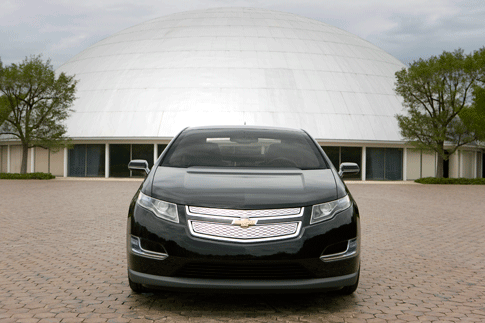
General Motors calls the Chevrolet Volt an extended-range electric vehicle. That's because the only motive force comes from the electric motor; the gas engine only charges the batteries. In a press conference earlier today, GM's CEO Fritz Henderson said the Volt will have a city mileage figure of 230 miles per gallon--almost five times more efficient than a Prius. But considering the uniqueness of the Volt's powertrain, how did the EPA get that figure?
Call it a "draft methodology." That's a quick way of saying the EPA is developing a few assumptions to populate a new "duty cycle" for the Volt. The duty cycle is the usage profile the agency uses when determining the city and highway mileage numbers to put on a new car's window sticker. The latest EPA cycle, set in 2006, accounts for actual driving conditions, such as high speed, aggressive driving, use of air conditioning, and cold temperature operation.
Of course, the Volt's fuel-consumption parameters are a bit more complex. Motor Trend reported a while back that such complexity had put GM and the EPA at odds over how to calculate the Volt's mileage. Apparently by today's statement from CEO Henderson (and all those "230" ads you've been seeing and didn't know it), GM and the EPA have apparently come to terms.
As John Voelcker from GreenCarReports.com points out, GM says the Volt can travel for the first 40 miles on battery power alone. That means, if you never drive more than 40 miles a day, your mileage is technically "infinity." Of course, that isn't quite accurate over longer distances. So the EPA likely adopted a test cycle that involves driving the Volt until the battery is discharged, and then for a further distance using gasoline power.
GM-Volt.com reports on a similar test routine proposed by Mike Duoba at Argonne National Laboratories, during which the Volt is driven repeatedly on four EPA highway test cycles until the battery is discharged, then drives one city cycle, totaling 51 miles. The EPA city cycle is just under 11 miles, the highway cycle about 10.26 miles. If you do the math, as Voelcker has, it works out to 232 mpg. Sounds familiar.
We'll be watching to see when the EPA gives up the goods.
[via GreenCarReports]
Stay up to date on the latest news of the future of science and technology from your iPhone with full articles, images and offline viewing
Featuring every article from the magazine and website, plus links from around the Web. Also see our PopSci DIY feed
Share links with friends, comment on stories and more
In our December issue, Popular Science names the 100 best innovations of the year: bombproof wallpaper, self-parking cars, the fastest helicopter, and 97 more. Plus inventor profiles and videos.
Check out the best of what's new here.
Why do people always fail to recognized you're still using fossil fuels to charge up the battery?
So they are not figuring in the gas used to initially fill up the battery to full before testing?? Or are they?
@bgres -- excellent point. Check out Ecoworld's calculation of cost per mile on the grid. The upshot is 3.4 cents per mile on the grid vs. 10 cents per mile assuming a car that gets 30 mpg.
http://www.ecoworld.com/fuels/electric-car-cost-per-mile.html
@Zengrath -- another strong point. The assumption appears to be that the initial charge will come from the grid. We'll have more on this as the details emerge.
Honestly I was very impressed by the mileage that GM is able to squeeze out of this car. One thing that makes me hesitant to buy such a battery intensive car (approx 1 gallon tank) is whether the car battery have a similar life to the battery life of our cell phones, ipods, laptops. Where you only get 80% of the full charge after 1 year.
This website has some really great articles on similar topics.
http://maggwire.com/articles/index/category:science
bgres: Nuclear is not fossil. Nukes make up 20% of US power supply; it could be much higher if the permitting process were streamlined. Wind presently makes up 9% in Texas and it's growing, although not at the pace it was a few years ago. Solar may also be deployed where it makes sense.
But as the author mentioned, the cost of energy produced by a power station is considerably less than the cost of gasoline, per unit energy. The power station, regardless of its source of energy, is probably twice as efficient as an internal combustion engine, perhaps even more. After transmission losses and losses charging the battery, you're still WAY ahead of in ICE.
When the ICE in the Volt does run, it can run in a very specific power band that is most efficient for its design, regardless of the speed of the car (since it's not coupled to the drive train). I recall that GM claimed that while the vehicle is running on the ICE, it gets around 50 mpg.
Here's a thought why not fully charge the car then fill the gas tank to the top.
Then, and here is the clever part drive a mixed course of city and highway driving until it runs out of both battery and gas then calculate the mileage
David:
The battery is designed to last the typical life of a car, or around 10 years. To meet this goal, the battery is kept within a specific charge range at all times though a computerized system.
yo! MP/KWH
They are talking like this energy is free. It is not. Now stickers need to give an MPG rating AND a MP/KWH rating.
As for your cost of KWH, that depends on what your normal and peak rates are for home, or if you plug in at the office, or if you are a government agency that gets "free" energy which is actually paid by taxing the public.
It ain't free, and numbers matter.
It charges overnight. It is not a Prius. Considering most people's power bill is about the same as a few tanks of gasoline, this will be cheaper.
The "fossil fuels still charge the battery zomgfail" comments are tiresome. Can you not see 100 electric cars powered by 1 plant is better than 100 gasoline cars run with 1 plant? The magically green Earth fairy isn't going to sweep all fossil fuels off the face of the Earth over night :)
I would rather use OUR fossil fuels derived from AMERICAN labor (coal mines) than use THEIR fossil fuels derived from oil shieks who are ripping off AMERICANS!!! So too would most AMERICANS. Let's keep the wealth in American instead of exporting ourselves into bankruptcy paying insane prices for OPEC oil. Best you learn that you morons.
Then too green energy sources are increasingly becoming commonplace sources of electrical generation. Solar, wind, geothermal, even nuclear is 'green' compared to coal. And natural gas burns clean too. We have 300 to 500 years supply of coal. Why not use it and starve OPEC to death? I say make it MANDATORY to manufacture all cars in the same fashion as the the Chevy Volt. Buy a volt and get a bumper sticker that says 'UPURSOPEC'
Coal can be clean as anything with CO2 scrubbers forced onto the industry. Sweden has a CO2 coal fired plant up and running already and it recovers all CO2 burned in the generation of electricity from coal.
This 230 mpg is 'city' miles. What happens when I hit the highway to visit the parents? That's the number I want to see and nothing I've read even gives a hint at that which means it's prolly in the Ford Explorer range.
wouldnt it be easier to charge the battery with a hydrogen fuel cell?
then basically all ur running on is water.
This is all propaganda by GM to get the stock price up. I don't know who they think they are fooling with this. Electricity is not free, and not everyone will be able to charge it at night during the cheaper rates ( if you are lucky enough to have a utility company that provides that )
I did a full writeup on the energy consumption of the volt
http://blog.whitesites.com/Chevy-Volt-Charging-Math-doesn-t-add-up__633585085743050177_blog.htm
The EPA does need to add some indication of electric consumption to the equation. It's part of the cost of driving. 230 mpg does not reflect total power consumed.
Electricity vs gasoline/diesel is a separate arguement. It's still worth knowing how much of each you can expect to use.
It's also worth knowing how these vehicles perform when operated outside of the 40 miles per day parameter. If there's a big surprise should you decide to take a vacation jaunt, it's worth knowing.
I don't know about the 10 year average auto life. A properly maintained vehicle can go well over 200,000 miles easily. This might well be a 15 year cycle. Energy required to build a vehicle is part of the carbon footprint.
Nothing against the Volt. These are just some things to consider.
@kstauff
If the battery is recharged at the appropriate levels with a computer chip then why can't a laptop, netbooks or even smartphones do that too?
Choi:
It seems to me that there would not need to be any incentive to put battery optimization technology in laptop, netbooks, or smartphones for the sole reason that the batteries in total cost value are inexpensive. Sure the ratio of battery cost to product in the aforementioned is probably near what it would cost to replace the intended batteries of the Volt. But if technology is cheap and you can integrate inexpensive batteries into a product then why reinvent the wheel? I mean, the manufacturer knows the life of the battery is finite. So peg the amps going into that sucker and get the battery life in the short term (the time the consumer uses the product) to be the highest as possible. But it would be cool to see a technology as mentioned implicated. Maybe it would drastically help!
Evolution "science" at work again? What kind of batteries does the Volt use? Are there enough raw materials on the planet to produce enough of those batteries for even US use? When are we starting to develop our off world mining capabilities? Children, you never know what they will put into their mouths!
@wowlfie
I think you're taking it a little too far in saying we can starve OPEC to death. We'll just open more room to China, India, and other rapidly progressing countries. It's not as though we're about to see a global embrace of this technology until we've finished toying around with it. That could be awhile.
so much better than stinky gassers. GO electric. Don't make the planet stinky.
David:
Actually, laptops and cell phones are programmed to shut off before the battery is drained dead. But those devices don't come with an onboard engine to generate more charge like the Volt does, so they can't "auto" recharge like the Volt (assuming it has gas of course).
from Los Angeles, CA
Very interesting! Using the number of comments on each article as a yardstick of consumer interest, EVs and extended range vehicles get far more attention (Volt: 22, Nissan Leaf: 16) than old-school ICE cars (Mazda ICE: 4, Camaro ICE 3, Ford ICE 3, Benz ICE, 2). I'm sure the MIT team would have gotten lots of responses except that the editors neglected to provide a link for such comments... I wish they had.
Now I'd like to see an intelligent article on the frenzy of activity in EVs in general-- even companies such as VW, who claimed they had no interest in non-fueled cars realizes where everyone else is going and doesn't want to end up on the bread lines like Detroit.
There are millions of ICE die-hards that get absolutely rabid as soon as EVs are mentioned... but EVs are going to replace ICEs, and sooner than later-- EVs are far more powerful, much cheaper to operate, and far, far cleaner in every way than ICEs. Broad use of EVs will allow us to keep the hundreds of billions of dollars per year we give to hostile OPEC countries, money we need to recover from the financial disaster of the last several months.
How about this... discharge the battery, clock the KWH to recharge it, run the car for ~40 miles to get the MPK then do the rest of the test for the MPG part.
Voelcker figured out that the car gets 50 mpg.
Now we need the mpk...
It is exceedingly difficult to compare the energy efficiency of any two cars who use even slightly different types of fuel. This will only get more difficult over time as we move to more electrics and other forms of power. The real solution to seeing how energy efficient a car is, in my opinion, is to use a universal unit that measures ENERGY used rather than a particular type of fuel. For example, using Joules, or, more appropriately, MegaJoules (MJ) or GigaJoules (GJ). We can argue all day about MPG vs MPKWH under different circumstances, but a MPGJ (miles per GigaJoule) for example will always be a relevant and comparable number. Then, below that number could be printed other equivalents for comparison, based only on the MPGJ conversion. For example let's use a gas vehicle that gets 30 MPG, noting that a gallon of gas contains 0.13 GJ of energy:
Vehicle thus gets 230 MPGJ, equivalent by doing to math to 30 MPG, equivalent to about 280 KWH of electricity, which at a rate of 10 cents per KWH is $28 for 30 miles or about $0.93 per mile.
Having a MPGJ number allows a straightforward comparison of efficiency, the rest of the info allows for easier comparison for a particular person's choices of which fuel to use and in which areas they live to purchase those fuels, etc.
I question the EPA's premise that the Volt "will save families money", no matter what the mileage. My Pontiac Vibe (which GM has decided is not worth building) gets about 27mpg around town, and 37 on the hiway. It cost around $18K. GM has said the Volt will cost around $40K, and initially lose money at that price. So just for round numbers, with $20K difference & $4/gallon, that is 5K gallons. Using 30mpg for my Vibe, it would still take 150K miles to make up the initial price difference, ignoring any fuel cost for the Volt. It does not sound economical for families or GM.
Even of 50MPG, the Volt pushes hybrid efficiency a little higher, how they factor in the 40 miles per charge off the grid is just PR. If you drive very long distances, that 40 miles is not going to do much for you. If your commute is near of under 40, then you have an electric car, on the market, set for mass production in the next few years, for 40K. You won't find that elsewhere.
You won't save money on it, but this isn't the car for someone on hard economic times. This is the car for someone who can choose to drop 30+ on a luxury car choosing to go green instead, since the efficiency is worth 1-2K a year (depending on driving habits).
I am also concerned about lifespan as well. 10 years is short for a car these days (12, 12, and 17 are the ages of my three vehicles, and they all run great). The last thing we need are use-and-toss disposable vehicles.
Add solar panels for at least AC to the roofs. Add power assist takeoff and magnetic linear shocks and double the drive time and miles. Ultracaps to assist-use small engines and large electric motors-charge half the battery system while using the other half! http://www.hedefnakliyat.com
Oakspar:
The 40 mile figure is derived from DoT statistics showing that 80% of commuters drive 40 miles or less daily, so they're appealing to a broad market there. Your assumptions about price vs. value are accurate in my opinion. This car will be pricey for what it delivers, but some would be willing to pay a little extra to own a vehicle that is not only green (that wouldn't be my angle), but energy agnostic, sourcing energy from a plug that is more than likely powered by domestic sources instead of foreign.
Hey guys, let me just say I love Popular Science readers!!! Everyone is so informed and we can actually have intelligent conversations. I've been a subscriber since I was about 15.
As far as the Volt goes you are all right. I have been an electric car enthusiast for years and have even built one out of a dune buggy and an old forklift for free. EV's, no matter how you slice 'em,are more efficient in the end, than the ICE cars. Unfortunately our progress is held back by various government and "Big 3" backdoor deals.
I've been following the various Lithium battery makers for a while now and if you do some digging you find a pattern. As soon as one of these companies like A123 makes a big break through they are bought up or contracted exclusively by some large oil, energy or car manufacturing conglomerate. Now this sounds good on the surface but it seems to be making these automotive level lithium batteries like "unobtainium" to the common consumer or upstart car maker. Companies like GM are famous for over engineering, so we will get an EV with a thousand pounds of silly things like GPS, Onstar, power windows and moon roof, heated leather seats, 600 watt sound system and gobs of plastic clad junk.
We need a EV like an R/C car......
Modular and upgradeable batteries motors and controllers. Simplicity in engineering. I can't afford a Volt but when I do get an electric car you can bet I will be tearing it apart that day.
Thanks for listening and keep it clean guys, we all mean well.
"We need a EV like an R/C car......
Modular and upgradeable batteries motors and controllers. Simplicity in engineering."
The components are the same, just bigger in Full scale cars
So Yes, Electric Car companies, please take note of this.
It can be made easy and simple, A monkey can do it, it is just a question of will they deliberately make it difficult to do so that they can capatalize on service/maintenence costs exclusively to them.
Someone said "Why do people always fail to recognized you're still using fossil fuels to charge up the battery?
That is not even close to being true. There are many ways to charge a battery without using fossil fuels. We have wind, solor and hydro for a start. And we have biofuels too.
Very true. New York, where I'm from has mostly nuclear and hydro power and wind farms are really taking off. I would feel good charging a car off the grid every night. By the way, I consider myself of average middle class means and employment for my area and I doubt I would burn gas in the volt any more than 4 days out of the month during the summer and almost none in the winter, unless it needs gas for heat.
I'm going to go fly my Lipo battery powered electric R/C helicopter now....HeHe
Mantisa
It’s another GM joke. This car company has never been straight forward about anything. I still remember GM boosting 20 MPG on a Hummer. An electric car is not rated in Miles per Gallon. It’s rated in Miles per Kilowatt. But because the Volt has a gas engine that is used to recharge the battery when it is low, there should also be a Miles per Gallon rating on that all buy itself. Given these to ratings you can figure out what the true cost is for drive the Volt. Considering the cost of the car and the battery life, you would be better of with a Prius.
The average internal combustion engine is about 25% efficient. Electric motors are about 95% efficient. The average thermal power plant is about 65% efficient. Hydro doesn't generate any appreciable GHG. Nuclear doesn't generate any appreciable GHG. IF the volt does half of what GM is bleating at us, it will help GHG emissions a lot.
Actually the most of the modern Otto cycle gasoline motor on the US highway are 40% efficient. 50% efficient gasoline motors are in the testing stage. If the automobile/truck makers were all required to replace the Otto cycle gasoline motor with the Anderson cycle motor, that would boost fuel economy to 70%. Merge lanes and ramps would have to be improved to allow for the slower excelleration of the Anderson cycle motor. I would rather buy a 2 seat in-line car that gets 200 mpg that costs $20,000 than pay $43,000 for a plug in 4 seat electric hybrid car. I part both of my Toyota Yarises in a private parking lot. I do not have access to a place to plug in a electric vehicle of any type.
So why didn't Obama make it necessary that the $4,500 "cash for clunkers" only be applied towards greener cars rather than just a newer gas hog that keeps us tied to the Middle East? As it turns out, most people are buying Japanese cars. Not sure what that accomplishes, since the tax payers are footing the bill. for that and the bail out.
What is most evident through these comments is that ideology plays the biggest part in the reaction the Chevrolet's Volt. It's really funny to read these comments from so-called science minded folks. And by funny I mean disappointing. One would expect to hear cries of joy for GM and creating a vehicle that is capable of such high mileage. Instead we have the anti-capitalists playing the same ol' game of GM bashing. I shutter when I picture the level of exuberance that would be poured onto this page had it been a "Prius" achieving these numbers.
from Los Angeles, CA
ellenbetty:
Your numbers are waaay off, for lots of reasons. For one thing, if you consider the actual amount of fossil fuel a gas car consumes, you must also consider that every gasoline car also needs its fuel delivered by a labor-intensive tanker distribution system that has thousands of smelly, noisy, inefficient, dangerous trucks criss-crossing our cities from one gas station to the next. Each of those tankers has a logistics support team of drivers, dispatchers, mechanics, and all the people and services they require-- insurance agents, office personnel, etc. That is far from a model of efficiency.
That is not the case with electricity, which is delivered by clean, quiet, non-polluting electric grids that do not congest our freeways and streets... they require virtually no maintenance for years at a time.
No engine with hundreds of reciprocating parts that must push heavy oils and coolants through mazes of circulation galleries can compete in efficiency with an electric motor with one moving part, that spins quietly and efficiently on its own center of gravity, and needs no mufflers, filters, catalytic converters, oil pumps, fan belts or other parts that choke off power and ensure inefficiency.
Gasoline was hovering at $5./a gallon last fall... it dropped to about $1/a gallon with the economic collapse around the first of the year... and even though we are still in a deep recession and fuel consumption is nowhere close to where it was a year ago, gasoline is once again on track to top $4/gallon by the end of the year.
Oil reserves dwindle at the same time millions of new middle-class Indians and Chinese are buying gasoline cars for the first time-- two of the world's most populous countries are now competing with us for what shrinking oil supplies are left, and you think that gasoline supplies will continue to stay below $4/a gallon? I'd bet my sweet bippy that by the end of next year gasoline will top $6/gallon-- probably more than $7/gallon-- UNLESS there is a sharp increase in electric car sales, easing demand for oil... and even then, gas prices are still bound to rise-- just not as quickly.
That's ironic, huh? If you wanna drive your gasoline car, you'd better hope everyone else is driving an electric!
I already have an electric car-- I'm not waiting for anyone to drive me in the poor house over gas prices. I converted a BMW coupe to an EV, so that now it is even more powerful than it was when it was using gasoline, and electric power prices are always more stable than that for fuels.
When solar panels drop in price a bit more, I'll put some on the roof of my home so I can drive nearly cost-free. If you stick with your gas guzzler, remember me in a few months when fuel is so expensive you'll need to start using the bicycle for daily commuting.
Billdale - You conveniently leave out many details in your arguments. Considering the points you bring up in opposition, I must assume its on purpose.
With regards to your comparison of an electric car versus a combustion engine, you must be completely without automotive knowledge in the electric arena. The Tesla certainly has a maze of coolant fluids running through the battery pack. In fact, it is more complicated than a simple car with rubber hoses. So much so, insurance companies will not insure the battery pack in auto accidents as it is VERY expensive to repair and replace. For every pushrod and piston replaced there is a very complicated computer management system that is working to extract every watt of power as efficiently as possible. That computer management system is actually run by a Xeon server processor, not a $2 chip from Taiwan.
With regards to being that much better for the environment, I'll take a page out of your book where you point out the growing demand for oil... what about the growing demand for Nickel? Or Lithium? Heavy metals needed for batteries. You think oil is scarce, Nickel is far less by THOUSANDS of times. Nickel is not even earth made, existing only at massive asteroid impact sites. So what happens when the battery demand goes through the roof? And what about disposal of these batteries? Nobody can guarantee recycling. Environmentalists think drilling for oil and stinky trucks are bad, I question if they have done any research into battery manufacturing. Any idea what the environmental impact is when procuring Lithium? Any idea what the chemicals and processes are behind Lithium?
The new energy discussion would be much easier if everyone could remove their emotional attachment to ideology and stick to facts. Blindly pushing any solution without understanding the facts just wastes all of our time. And it begins with the simple understanding that these issues aren't simple and technology isn't just sitting on a shelf somewhere in evil GM's warehouse. Any solution is much more complicated than what can be presented in 5 minutes of Google searching.
from Los Angeles, CA
Piablo--
You're making lots of errors in logic and comparing apples to oranges, making your entire comment useless.
You obviously have some knowledge of the Tesla, and if so, you must know that it's the most elite of EVs-- they go to lots of trouble to make it high-performance, at the expense of complexity. I have an EV conversion, it does not need a cooling system; I have lots of friends that have EV conversions, some of them have been running for years without problem, and none of them have got cooling systems. Just because you can point to a very exceptional case that has cooling, does not mean all EVs do. The Mini-e electric Mini Cooper, for example, is also very high performance and has NO moving parts other than the wheels themselves.
It's absurd to say that the Tesla is mechanically more complex than a contemporary gasoline car-- and all those hundreds of reciprocating parts in an ICE lose inertia with every stroke. Electric motors and other parts that turn on their own center of gravity and only have two small bearings in physical contact conserve their momentum, and are far more efficient than any ICE!
"it [the Tesla] is more complicated than a simple car with rubber hoses..." Wrong! I doubt you've ever even seen a Tesla, much less ridden in one... a Tesla, even with its cooling system, is mechanically far simpler than the simplest Kia, and far more efficient. Yes, it has lots of electronic parts, but as anyone knows that still owns a transistor radio from the 1960's, solid state electronic systems are far more reliable than mechanical systems with moving parts and metal-to-metal contact, and corrosive fluids that need constant periodic changing just to delay their inevitable failure-- EVs need no such oil changes, no tune-ups, no smog tests... they are not even likely to need brake service for decades due to regenerative braking.
"For every pushrod and piston replaced there is a very complicated computer management system..." Apples to oranges! Those management systems (called controllers) are solid state-- again, very reliable, and are quickly becoming smaller, less expensive and more efficient, just as the "car phones" of the 1980's that cost thousands of dollars are nowhere near as efficient, versatile or inexpensive as a BlackBerry or i-Phone.
"...what about the growing demand for Nickel? Or Lithium? Heavy metals needed for batteries..." again, apples to oranges! Every gasoline car needs a constant supply of NEW oil for its fuel-- unlike the lithium and other metals used in EVs, which can not only be used for decades without being replaced, but once they do wear out, the components can be efficiently replaced.
(The City of Santa Monica, CA, has a fleet of Toyota RAV-4s that are more than a dozen years old-- their batteries don't even show a decrease in storage capacity. Altair NanoSafe batteries can be charged and discharged tens of thousands of times... the equivalent of 80 years of hard use... without loss of capacity, and the materials are so benign as to be used in toothpaste, house paint and other common household products.)
Once the battery materials are worn out, they can be recycled back into new batteries-- just as aluminum cans today are recycled back into new aluminum cans.
Lithium is one of the most plentiful metals on earth. Only recently have we begun to see its use in batteries, so it is too soon to tell how much of it is available here in the US, but it can be extracted from sea water. It is in trace amounts nearly everywhere. There are large deposits in Bolivia and other South American countries, and parts of Asia and Europe as well.
"what about disposal of these batteries?"-- any kind of battery will not be DISPOSED of, any more than lead-acid batteries today are DISPOSED of-- lead-acid is worth no where near as much as lithium is or will be, and its very value when recycled will guarantee a high rate of recovery-- more than 98% of all battery lead is recovered.
"Any idea what the environmental impact is when procuring Lithium?" Yes, I do, but not as much as I'd like-- and there is no use of any natural resource for anything on the planet that's not disruptive, so that question is nothing more than empty rhetoric! What products can you name that have no environmental impact?!
All you've succeeded in doing is pointing out that building EVs will not be perfect, that there will be some bit of pollution or environmental damage at some point, but so what? There is no solution that has less environmental impact than the rapid switch to EVs.
Once an EV is made, if the battery is sensibly maintained (most battery chemistries can survive almost indefinitely if you follow strict charge/discharge protocols), and we use our roofs for solar panels to cleanly charge our EVs, the footprint of an EV can be far smaller than that for any vehicle using other means of propulsion.
Until GM actually produces and sells a Volt, I could care less about thier claims.
I just had a thought though, who in their right fricking mind would even think of buying a Volt? GM received about 50 billion of our tax dollars and we are supposed to give them another 40 grand a pop for the Volt. Not in this lifetime GM. You owe me!
Electric motor power requirements change with every degree of temperature change (electrical resistance changes 0.4%/°C). For all you non-physics majors, this means the resistance of electric motor will drop, allowing the motor to draw more amperage in cold weather than at 70°F (25°C). In hot weather, the motors will require more voltage, as the resistance will increase.
It was mentioned that the EPA makes some assumptions regarding weather among its "driving conditions." Were these assumptions modified to account for electric motors?
Hot and cold climes will have greatly varied mpk and mpg figures. I don't think the Volt will be a big hit in International Falls, or Yuma.
Well, 70 plus years after we switched from steam to electric trains, we finally have a car that uses the same technology. The diesel engines in a train don't power the wheels. They power the generator that powers the electric motors that drive the wheels. That's what this car does, and that's why, even after the 40 miles of battery only use, GM is confident that the mpg will still be over 100 or more. (triple digits) Quite an achievement, and for the millions of environmentalists out here who will gladly fork over 40k to own one, quite a bargain. In fact, the only thing wrong with this picture is that GM is only going to make ten thousand the first year and fifty thousand each year thereafter. Not nearly enough to keep up with demand. They should make at least fifty thousand the first year and ramp up from there as the market demands. Anyways, I hope they make millions of these and sell them all. This is the beginning of cleaner air and an end to the tens of billions in subsidies we are spending each and every year to protect our access to foreign oil.
Thanks
sherone
http://www.bulk-sms-4u.com
hi that car is cool i think i am getting it not shore its cool bye
I toured the GM VOLT line, and was told that the Volt gas engine does not charge the battery, so when the battery is down, it waits to be plugged in to the cheap power, but braking during gas use will charge the battery some.
This keeps from using expensive gas to charge the battery.
As far as comments that the car should be battery only, realize that this car is built so that it will run as a battery car, but if you forget to plug it in, have to make an emergency trip, decide to take a long trip once in a while, or the battery fails for any reason including collision damage, you can still use gas. I understand that the Leaf has GPS and a radius display to make you ever aware that you can't leave the area. Imagine this radious display shrinking? How would it feel to be battery only if you got a call to come to a family emergency, etc. I thought the Volt might be wrong, but I GOT IT! It has gasoline backup! And as batteries improve, and when the Volt is used for the purpose it is built, the backup might be only used occasionally. It was quoted by Bob Lutz, I believe it was, that one problem with this car is how to get the old gas out of the tank when you don't use it. Good problem to have. (You could run it out every now and then, of course)
J. Weinberg
I sent a comment (see below) to the editor. The very title of this article is misleading, since it is based on a misconception.
This car is built for a particular purpose, which is normally somewhat limited range (for now), and when used for the purpose it is built for, the MPG is possibly much higher that 230. Realize that the MPG for electric cars needs to be calculated based on a certain price of gasoline vs a certain cost of electricity. The MPG equivalence is for cost comparison, of course.
Also, the gas engine in the Volt is for full BACKUP to the battery, providing security and piece of mind (see my above comment), until the battery can be charged. Any mistake, and a battery only car will strand you, unless you can find a plug, and wait... and wait....
Or call www.batcharge.com :-)
-----------------------------------------------------
To the editor/writer:
The article that Mike Spinelli wrote that I saw on the Popular Science website about the Chevy Volt says the info was [via GreenCarReports] .
If you read the original report, and since I toured the GM Volt line two Monday's ago, and it was stated to me face to face by the engineer, you will find that the statement that the Volt uses the gas engine to recharge the batteries is incorrect. This point was supposedly gleaned from the report that did not actually state that the gas engine charges the battery, making the Volt look bad. The gas engine was even seen as a point of contention, but the truth is that it is actually a major benefit (see below).
The Volt gas engine only generates current to run
the motors and power the car, only after the battery is
exhausted - it does not recharge the batteries. The
batteries are only charged by being plugged in, or by
braking. This saves gas in ANY case. I was told
this face to face by the engineer on the GM line
building Chevy Volts, during a tour. He stated that
there is a major misconception that the gas engine charges the battery - it does not.
This allows the gas engine to be smaller (my guess),
and not waste gas charging batteries (his words). This
gas engine gives huge physical security and psychological
advantage to the Volt over a battery only car, since one
can, at some gas penalty, take any extended trip, even
drive to work or in an emergency, including battery failure,
even if somebody forgot to plug it in last night - "Honey,
did you forget to plug the car in last night?". "It wasn't plugged
in when I got in it".
(I threw out the first comment at the car we saw at the
line, and a person in our group countered. We just
predicted the future, and the battery only car that you forgot to plug in would stop that trip to work, the store, or even the hospital. Think about it.
With the Volt, you just pay some $ for gas, and go on.)
Please correct this on the website and everywhere else this is stated in error. I was told that the Volt gas engine does not charge the battery (you surely have ways to verify this). Please have anyone with questions contact me. We can contact GM as high as necessary to resolve this misconception, and show why this design makes good sense.
J. Weinberg
Well, new news says that the battery has a reserve that is used after the 40 miles on battery is exhausted in order to not limit acceleration, etc. The new news is that the gasoline engine does charge the battery back up to that reserve point so that the reserve stays in reserve. I believe the reserve being kept is why the Volt only gets 40 miles on a charge - I was thinking they used to say 60. The 30% reserve would account for the firgue now being only 40 miles per charge.
As far as whether this saves enough gas to be worth it, consider, even though it might only save a couple of gallons per day right now:
Surely China and the other contries will strongly increase competetion with us for oil, and that oil reserve exhaustion will become a point with the news, etc. Guess what happens then? What if gas goes to $7 or $10 per gallon, or rationing happens, or if refineries have a major outage (hurricane or terrorism)? We are shut down!
The USA (we) created the technology for the machines (cars and trucks) that are now being mass produced worldwide, making the entire world hostage to oil. If we don't at least get started on another technology, then the whole world (that's us, too) is in big trouble for being at the mercy of one energy source - oil. We must get started on getting out from under this. If we have a lot of battery cars on the road, at least the whole country will not stop when the oil goes up or stops, as in case of a panic. If your neighbor spent the money to get one of these, maybe he or she will give you a ride to the store, work, or the hospital. It might just save your life or family. We must get this insurance to our way of life out there. Think about it. Don't just worry about which political team is in power when it is being done. This is not a football game where you stop the other team! Forget which team you are on, and look at the consequences if nothing is done!
Go USA! Go EARTH!
J. Weinberg
That's mostly correct. While the Volt's engine-generator will recharge the battery to a degree, it will not return the battery to a “full” state of charge. The battery will get some manner of recharge from regenerative braking. From GM: "When the battery’s energy is depleted, the Volt seamlessly switches to Extended-Range mode. In this secondary mode, electricity needed to power the vehicle is created on-board by a flex-fuel powered engine-generator. This mode of operation extends the total range of the Volt for hundreds of additional miles, until the vehicle can be refueled or plugged in to recharge the battery."
http://media.gm.com/volt/eflex/works.html
Still lots of questions to be answered, like will the car's performance be significantly limited in Extended-Range mode, and will the Volt be drivable with no gasoline in the tank?
the chevy volt is the greatest car ever created by chevy!!!!! I am so excited about its debut!!!!
Hey I just wanted to get everyone fired up on the issue again. Your homework for the weekend is to go watch the movie "Who Killed the Electric Car".....
@Bigswampthing
GM may have killed the electric car, but I think that the Volt is a big step forward in the right direction. Hopefully this car will be everything that it's hyped up to be.
Why is everyone talking about the cars? Are you forgetting that our electrical infrastructure is already falling apart? Calculate the extra capacity needed if only 10% of fueled cars were replaced tomorrow with battery cars, and you'll begin to see the real problem. Not only is the electricity not free, it's going to require a total overhaul of our electrical transmission system to replace gas stations with charging stations, regardless of where they're located.
The Volt is indeed a good start. Many smaller car makers are doing a bit better with their minimalist approach including one who is building a factory right near where I live. Many are starting to adopt a replaceable battery pack.
As far as the electric grid and infrastructure issue: that is mostly coming from the nay sayers in the oil industry. First of all, all of these cars are designed to be charged on household current. Most will even charge on standard 110 plugs, just slower...like over night. The first generation of electric cars with say 100 mile range will not need a "charging station" every 10 miles along the road. The people who own these cars will be very attuned to their limitations. You drive to work and the store and charge it every night. Simple.
Electric utility companies are resonably capable of keeping up with the demand of urban sprawl so why would they not be able to keep up with the advancement and adoption of the ELV?? There are more houses being built in my town than electric cars.
As far as the dreaded "dying electric car so far away from home " issue....most places have outlets and will let you plug in. Watch, it will become more and more common for places like Walmart, supermarkets, your job, and multitudes of other locations to have charging plugs set up for you. The cost would be minimal in relation to the good PR they would receive.
10% of gas cars will not be replaced tomorrow. Logic will prevail and we will adapt eventually. Lobbyists in Washington are the true enemies to the advancements we seek.