German automakers plan a full re-imaging of a Cold War East German relic
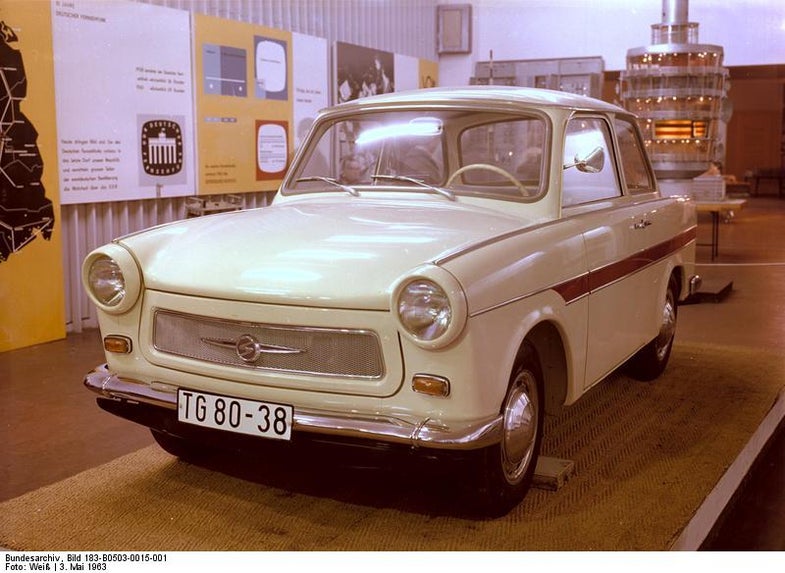
Trabi German Federal Archive

In what could very well become the auto industry’s greatest comeback story, a trio of German companies is hoping to introduce a revamped version of the pride of DDR auto engineering: the Soviet-era Trabant.

According to the prototype the three companies plan to unveil at this year's Frankfurt Motor Show, the Trabant nT (as in Neu Trabant!) will be powered by an all-electric drive train, sport solar panels on the roof for juicing the AC and have a range of up to 150 miles.

Better known as a "Trabi," the car gained notoriety during the Cold War era as the slow (top speed: 75 MPH), smoke-puffing, gas-guzzling symbol of Communist utilitarianism. Over 3 million Trabis were made over 30 years, until production stopped in 1991, right along with the fall of the Soviet Union.

The companies behind the idea—German auto parts maker IndiKar, engineering group IAV, and toy (yes, toy) car producer Herpa—plan to unveil the prototype of the New Trabant at Frankfurt, which opens September 17. There, they’ll be on the lookout for investors willing to fund the venture and help bring the cars to market by 2012.

Commercial availability is definitely looking likely given the Trabis’ cult-like following and Germany's love of anything DDR kitsch (see: Ostalgie, or nostalgia for the East, and Ampelman East Berlin's infamous crosswalk man). In fact, Herpa first got the idea for the new-and-improved Trabis when its mini toy versions of the original car proved a wild success, with sales numbering in the hundreds of thousands. From there, the company went on to propose a revamped Trabi at the 2007 Frankfurt Motor Show, where a quick poll of the Germans and other Eastern Blog fetishists present demonstrated that yes, there was appeal.

If these puppies do hit the market, let’s hope they’re easier to secure than their Soviet era counterparts, which at times came with a 15-year waitlist.

[Via Physorg.com and TheAge.com]

Want to keep track of the latest concept cars, automotive innovations, and more? Subscribe to Popular Science and enter to win $5,000!

3 Comments

billdale

from Los Angeles, CA

I'm glad to hear they'll be making EVs, but it's too bad they're not starting from scratch-- the Trabi does not appear to be very aerodynamic, and bodies designed for engines, gas tanks and mufflers are not usually very efficient for converting to batteries and an electric motor. I hope they do well regardless.

I think this is a very efficient disign because of the use of old cars(new cars would olny add to the pollution) and the design cost ,new plants,and robots needed to produce cars would be a waste of materials.Old cars are very sturdy and safe because they are made of solid steel casts not sheet metal or plastic(as in suburus) Also older cars have fewer pars(less money for repairs) but new cars have chips and complex fuel injection systems that olny a skilled automechanic can fix and are design to last for 5 years not forever like old cars.I aplaud their efforts for recongizing the efficienies of old technology.

It's sad how european companies put american automakers to shame,with cheaper and more efficient vehicles, when we get stuck with whatever crappy electric car gets shluffed out(like the volt, which never was truely released.

Popular Tags

Regular Features


Download Our iPhone App

Stay up to date on the latest news of the future of science and technology from your iPhone with full articles, images and offline viewing


Grab the Tech Buyer's Guide iPhone App

Carry everything you need to make a smart buy on HDTVs, cameras and 14 other product categories right in your pocket


Follow Us On Twitter

Featuring every article from the magazine and website, plus links from around the Web. Also see our PopSci DIY feed


Become a Fan On Facebook

Share links with friends, comment on stories and more


February 2010: Renovating America

Innovative fixes for five of the country's biggest infrastructure messes, plus a look the quest to read the human mind, the LCD screen that might finally kill paper dead, and the world's scariest science.

Read the issue here.

Popular Science Photo Pool


Share your photos in the Pop Sci pool at www.flickr.com!