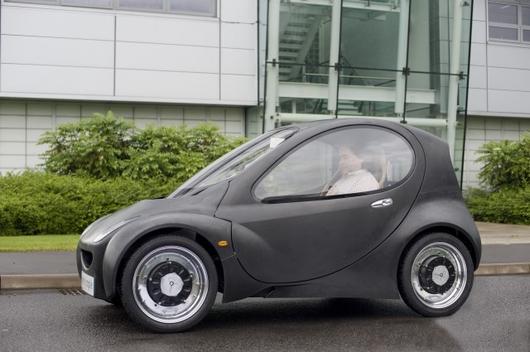
The Riversimple Urban Car was nine years in the making. But when the diminutive, hydrogen-powered prototype debuted in London recently, the biggest difference between it and other fuel-cell vehicles wasn't its in-wheel electric motors or banks of ultracapacitors. It was its development-and-business model.
The two seater is the work of Hugo Spowers, a former motorsports engineer. Spowers not only developed the car and its powerplant, but also its nonconformist R&D philosophy. Plans for the Riversimple Urban Car will be “open source.” Like a Wikipedia entry or the Firefox browser in which I'm typing this post, the Riversimple will be open to tinkering by a community of experts free to download the plans and make their own changes. Spowers says open collaboration on the Riversimple car will speed development and improve the end product.
The plan is also not to sell the Riversimple, but to lease them. Manufacturing won't take place in a city-sized factory owned by a single, giant automaker, but distributed to small, local factories.
The Riversimple weighs only 772 pounds and emits less than a third of the C02 produced by the newest hybrids. Propelling force comes from four in-wheel electric motors that can regenerate electricity during braking, stored in a bank of ultracapacitors to be reused to power the motors during acceleration. Its light weight allows for a mere 6kW fuel cell, not the 100 kW found in Honda's FCX Clarity fuel-cell vehicle now in fleet testing.
The company needs $32.5 million in investments to make the Riversimple project a driveway reality.
[via Gizmag]
138 years of Popular Science at your fingertips.
Each issue has been completely reimagined for your iPad. See our amazing new vision for magazines that goes far beyond the printed page
Stay up to date on the latest news of the future of science and technology from your iPhone or Android phone with full articles, images and offline viewing
Featuring every article from the magazine and website, plus links from around the Web. Also see our PopSci DIY feed
Science is reinventing play, from extreme sports to gamification to ridiculous roller coasters to the playgrounds of tomorrow, and this issue is chock full of fun. Also, on a less fun note: Did global warming destroy my hometown?
I would use it to drive to work. If leasing would cost me similarly to my car costs, it would be good enough.
I would use it to drive to work too... if they show me what would happen if one of the crazys out there decided to hit me in a head on, or T-bone collision.
My guess @ 772 pounds vs. 4500 in a full size pickup, is it would make for an interesting PopSci article.
from Ojai, California
I can only imagine these things would be cheeeap. If everyone started using them for commuting or errands, there'd be less risk of hitting a large car because there'd /be/ less large cars.
Not picking on jmfb_k7, because I have heard this before, but the "what if a full sized, two ton vehicle crashes into me" argument is old and lame. Motorcycles, scooters, etc. perform essentially the same (or worse) in crashes with much heavier vehicles. Yet they sell quite well and are used by a large number of people all over the world.
In terms of safety, I would expect it would still be much better than a motorbike or bicycle... and we still allow those on the road today.
dude, that is exactly what the world needs!
$32.5 millions? That's it??
Give it to them NOW!! This is Awesome!
sweet.
how many miles does it get on one tank?
Gary K ;It takes a great deal of Energy to bring Hydrogen to a state that it can be used for Energy,and to convert a Vehicle to operate on it.Gasoline can be safely converted into a Vapor that's 100 parts of Air to 1 part of Fuel.With this, even the largest SUV could easily get 50+ MPG, & emit a fraction of the Emissions of an EPA mandated 14.7/1 Air/Fuel Ratio.Do a search on Tom Ogle,& http://energy21.freeservers.com/bookrep.html & check out the bottom of the Page.But, when a Vehicle Emissions Test is done,Oxygen [O2] Exhaust Sensors must detect a level of pollution that would indicate 14.7/1.That's the Law.Thus, it is entirely possible to fail an Emissions Inspection for not generating enough pollution!My Photo is of a Vaporizer, ignited to prove that it works.Big Oil & Big Government have outlawed it,and Obama can't change it.If we are ever to get away from Oil, this has got to change!
That is awesome. Now if they could only make it look cool, then they would have buyers other than a limited number of hippies out in California
http://prosportnutrition.net/?a=633808700294218750
jerrydd
As someone who builds and drives EV's every day this is not going to work cost effectively.
Why is the wheel motors, controllers have to be way to powerful, thus too costly, to start up a hill.
Next is there are no cost effective ultracaps being 100x's or more than Lithium batteries.
Fool cells are so ineff only going 1/4 the distance on the same base fuel as a battery EV. H2 gal equivalent is over $10 not including it's storage container.
Now had they said a single motor with a good reduction gear so the motor could get enough rpm to make power, torque cost effectively and used lithium, Nicad or even lead batteries with maybe a 5hp ICE generator for extended range then yes I'd say great.