Test Drive
Does the hotly anticipated plug-in hybrid Chevy Volt have a shot at rejuvenating General Motors? We took a prototype version for a spin to find out.
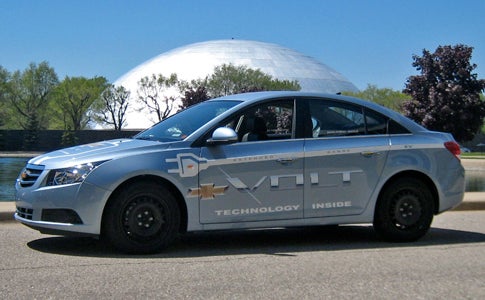
Chevy Volt Prototype A Chevy Cruze fitted with the Volt powertrain Seth Fletcher

Reporting on a test drive of a new car is generally pretty simple. How does the car look? How does it feel? Does it hang with its competitive set? How many parking-garage attendants told you it was awesome?

Assessing a pre-prototype version of the Chevy Volt is, um, different. To start, it’s not a production car. Then there’s the context. The Volt lies at the intersection of some of the most contentious issues of the day—electric cars vs. next-generation gas or diesel engines, CAFE standards, greenhouse-gas restrictions, the federal bailout of the American auto industry. Some people still refuse to believe that the Volt is actually a production-intent project. But after driving the car earlier this week, I can testify that the Volt is definitely real.

The final iteration won’t roll off the production line for another year and a half, and yet die-hard fanboys and unhinged haters have been brawling online over the car for more than two years. The Volt—which, in case you haven’t heard, is an extended-range electric car that runs 40 miles on a single charge of its huge lithium-ion battery pack before a 1.4-liter I4 flex-fuel engine kicks in to power the electric motor and keep you going until you run out of gas—is a Hail Mary pass from what was once the greatest automaker on the planet, an industrial giant that has now fallen into the cold embrace of the federal government. And so evaluating a car like this becomes tricky. Talking about the cornering ability of a car so pregnant with significance feels absurd, particularly a day after President Obama announced historic, strict new nationwide fuel-economy standards designed to prod along the production of hyper-efficient cars just like the Volt.

Nonetheless, this Monday, on the company’s Warren, Michigan Tech Center campus, a few other journalists and I were allowed behind the Volt’s highly contested wheel. Semi-retired GM product czar Bob Lutz was on hand to prep this test drive with a plea for perspective:

“I’d just like to remind members of the media at all times, dial yourself back about 27 months to the Detroit auto show of January 2007, when we showed the concept Volt and announced that we were exploring lithium-ion technology,” he said. Remember the scorn, the contempt, the instant criticism from “a famous automobile company that starts with a “T.” “Here we are two and a half years later and we are totally confident about the technology.”

Volt vehicle line executive Frank Weber provided further caveats. Don’t pay much attention to road noise and handling, because the next year and a half is all about dialing that stuff in. Don’t pay attention to the interior, because this car is, after all, a Chevy Cruze fitted with the Volt powertrain. This drive, he said, was about propulsion—about batteries and motors. “Public still has opinion that electric cars are handicapped,” he said. “We want to prove that it’s capable of being the first car in the household.”

Our test track was a busy corporate campus with a heavy presence of Canada geese and their goslings, so aggressive driving was pretty much out. Once I strapped in, I politely eased it around the campus as if circling a mall, looking for a parking spot. In this pre-prototype version, the road noise—a constant crunching and whining of the tires against the pavement—was surprisingly loud. Weber, who sat shotgun, assured me that he was not happy with the level of road noise, and that much of it would be hushed out over the next year and a half.
Chevy Volt Prototype Drivetrain:  Seth Fletcher

After a few laps around a campus lake, I realized what was so remarkable about the car: That once I forgot about the novelty of the silent electric drive, and once I stopped thinking about the hype and the controversy, the Volt seemed unremarkable. In a good way. A refined, nicely equipped version of this would be a real car—not a glorified golf-cart or a conventional vehicle clumsily retrofitted with a giant battery and an electric motor. The Volt mule reminded me of nothing so much as a silent version of a standard late-model Nice Sedan—a silent, gas-free version of, say, the Mazda 6 I test-drove earlier in the week. That’s a compliment: I like the Mazda 6. (The comparison also puts the moaning over the Volt’s projected $40,000 price in perspective. Subtract the $7,500 electric-car tax credit from Volt’s sticker price and suddenly you’re cross-shopping the Volt with an (admittedly heavily optioned) $32,790 Mazda 6 Grand Touring sedan.)

Once I grew bored with the respectful driving I asked Weber a leading question: “What else should I do with this before my time is up?” He supplied the answer I was looking for: “Go over by the lake and do some heavy acceleration.”

I stopped the car at the beginning of the longest stretch of road I could find, waited until it was clear of geese, and then floored it. As we rolled forward, quickly but not wildly, I couldn’t help but wonder: Where’s the tire squeal? Where’s the roar of the engine? But within a matter of seconds I was at 55 mph and out of road. I did it again, psychologically prepared for the lack of internal-combustion drama. It was exhilarating but anti-climactic. I want to know what it’s like to drive this silent ride at 100 mph, its electronically limited top speed.

Back in the garage, Weber and I stood behind the car and talked about the big picture. As Lutz had earlier, Weber confirmed that the Volt is still on track to for November 2010 production. It’s not clear how long after that you’ll be able to buy one. Actually, it’s not clear you’ll be able to “buy” one at all. According to Weber, the cars may be for lease, or they may be sold with certain incentive packages. This hasn’t been decided.

As everyone began to leave, I talked to Volt exec Tony Posawatz, who was grinning and bouncing on the balls of his heels as if it were his birthday. Like all the other GM-ers in attendance, he seemed to be blocking all thoughts of financial apocalypse. Actually, he was downright buoyant. Next week, the first of 75 production-intent prototypes was set to arrive. According to the Volt team, the things they can control are, in fact, under control.

Want to keep track of the latest concept cars, automotive innovations, and more? Subscribe to Popular Science and enter to win $5,000!

17 Comments

I'm really hoping they pull this off and the new CEO Obama doesn't pull the plug on this. What better way to get off foreign energy sources and reduce emissions than with this kind of car, all while being built in the US.

foreign energy sources are important to the global economy. And an electric car will not mean that "we" will stop buying oil from abroad :)
Goood to reduce emissions tho, smog sucks.

I think that there are some real keys here that deserve more than the "environmental" hoopla:

(1) Made in America. You can't beat that with a stick. Mass produced in America for export: even better.

(2) Quiet is bad? Sure, no "gun of the engine." The only people I know who gun engines and squeel tires are stupid teenagers who don't care what they do to daddy's car or with mommy's fuel. If it goes, it goes.

(3) Quiet is bad? Cars are a leading source for noise pollution. Cities will be much nicer places to be when the traffic noise is ruduced to rubber-road, wind resistance, and only ocasional electric generation from the engine.

(4) Global oil is limited. It has been the US's long term strategy to "use their's first." This actually extends that strategy. In a high consumption model, as peak oil is reached, demand and reduced supply increase price, leading to forced conservation and preventative conservation (by nations choosing to artificially raise the prices against future demand and reduced supply). If you can, however, reduce demand as supply is reduced, then prices stagnate as countries try to maintain revenue with increased output.

The US wants the Middle East to run out of oil. Once that happens, the region descends back into obscurity and the US position (with more of our latent oil supply intact) are in an advantageous position to continue with petroleum production.

(5) These cars are cheaper to run. Even if they are not cleaner, coal (electricity) is cheaper than petrol and will only continue to be so.

All I see is the transfer of oil to the plant that has to generate the power to charge the thing. Where are we saving oil?

I hope GM does well with the Volt, but resent the Federal tax credit, just as I dislike the "gas guzzler" tax. I know it is wishful thinking, but let the marketplace decide what is or isn't viable - and get the government out of trying to shape our behavior. (Too late, now). A good example of unintended consequences because governmental meddling: SUVs came about because they were not part of the fleet MPG average (regarded as trucks).

The Tesla is likely to be a bigger hit - the early adopters will pay the premium for more advanced styling and better performance.

palanan_0987

from Grande Prairie, Alberta

I prefer this car over any car made by anyone else. Did you know that the image of America lies not only on the quality of the product that goes out for export, but also the economy right now is dictating that we must reduce our ever increasing oil consumption. Oil in the Middle East is not the most valuable thing ever created. We should relax for a moment and think. Will this help my nation in the future? Will this help me and my children in the future? Americans today are having a bad rap of being the place for trash, too much consumerism, etc. America in my opinion is a great nation because of the people who live in it, the Americans. Be proud America and say to the world "I am a good American, and I will help the world through setting an example of a sustainable way of living."

What happened to the electric car that GM brought out several years ago? It was capable of doing 75 and traveling 180 miles on a charge. Plus it would out run a Corvette for about the first 150 feet. They were not sold but leased. Then suddenly they started recalling all of them and distroying them. The neat thing was that it was a cross between a small sedan and a sports car. Bring it back!!!

Hybrids and battery cars are an expensive and tragic joke.

The Honda FCX Clarity is proving itself everyday. Hydrogen fuel cell cars are the only viable answer.

It's a start.
You don't have to wait for Hydrogen feuling stations to be built in your area like you do with the Clarity.
The price point needs to come down somehow. $600 a month lease on a Clarity and conceivably the same with Volt. This puts it out of many consumers price range and will delay acceptance into the mainstream.
If you are worried about coal, buy solar panels. Konarka technologies and Nano Soler have been producing flexible material solar panels that are getting cheaper. They can't keep up with the demand they are so popular. Companies like this could produce a car cover that doubles as a charger right now. I'm sure too that if Hydrogen feul cells become more of the norm that there will be backyard scientists out there producing their own from water instead of using the stuff refined from oil. Scary but true.
Only time will tell but I think this car has a good chance of selling in the urban commute areas.

Lets not forget GM's EV1 which was released in 1996. This 'electric' version has been in the company vault for many years and now they release a 'new version' that has gas/deisel component. Why? Why not go completely electric?

If you want to get your brain thinking of all the components (consumer, manufacturer, political, oil/gas industry) of this energy-saving idea, you should try to locate the documentry video called 'Who killed the Electric Car'(2006). Based on the EV1 and it's demise in 1996.

www.sonyclassics.com/whokilledtheelectriccar/electric.html

www.pbs.org/now/shows/223/

this is going to work as well as the communist ideas of the government now in charge of what used to be a company.dream on ding dongs.

Now for the shocker! "The most important deposit of lithium is in the Salar de Uyuni area of Bolivia, which holds half of the world's reserves. According to the US Geological Survey the reserves of lithium in Bolivia are estimated at 5.4 million tons, compared with 3 million tons in Chile, 1.1 million tons in China and just 410,000 tons in the United States. The lithium reserves are estimated at 30 million tonnes in 2015.

Seawater contains an estimated 230 billion tons of lithium, though at a low concentration of 0.1 to 0.2 ppm."

--wikipedia--

You would still be buying an energy source from another country.

The BBC has more on how restrictive Bolivia is being about the resource.

http://news.bbc.co.uk/1/hi/business/7707847.stm

With regard to foreign energy sources, I am first and foremost concerned with the energy security of my home country, the United States. It's the business of other countries to pursue their own energy security. Since the US has vast reserves of coal and natural gas, and significant oil reserves as well, it is in her interests to develop efficient, clean electric vehicles powered by these domestic sources.

With regard to lithium reserves, the lithium chemistry that is presently favored for batteries is not likely the last chemistry that may be used. For that matter, batteries themselves may be replaced with ultracapacitors like EEStor's or Graphene Ultracapacitors'.

One of the primary benefits of the electrification of cars is that they are energy agnostic. They may be charged by power that is sourced from fossil fuels, nuclear, wind or solar. This decouples the car from oil and creates natural competition between these sources.

Since fossil fuel burning plants are nearly twice as efficient at converting the energy of a fossil fuel to electricity as an internal combustion engine, and because electric cars are nearly 90% efficient, there is a significant increase in the overall efficiency of transportation. Further, any pollution, real or perceived, may be captured much more easily at a power plant than with smog pumps and other mandated systems installed on today's vehicles.

Much of the infrastructure for electric vehicles already exists, although more electrical production would likely be needed in the future. Maintenance costs for electric vehicles would likely be lower as electric motors are far simpler devices than IC engines. And a large fleet of electric vehicles could even buffer power to help prevent brownouts that have been occurring with greater regularity.

Lastly, I'm not advocating driving around in golf carts. Tesla has already shown what I think is an excellent example of an appealing electric vehicle, and Fisker is following suit. Next up, a pickup that can do 0-60 in 8 seconds while hauling a boat. Aim high, and get off the oil teet!

$40,000 out of the box, doesn't that eliminate over 1/2+ of the car buyers.

I agree with previous posters. $40k is way too high. Selling people based on long term savings won't work for the demographics that GM has targeted through years of micro marketing. Gas would have to cost at least $6 / gallon for people to consider the volt. The volt's estimated costs are based on 10 cents / KWH. All you are really doing is transfering your money from the gas pump to the utility bill. There is no savings. The Volt will be the end of GM.

http://wheresthestripclub.com

billdale

from Los Angeles, CA

.
What I find most heartening is not the Volt story itself, but the decidedly positive (and mainly informed) overall responses from the readers. Interestingly, the few negative comments were from those that were the most ignorant-- "Harlyrider", for instance:

"All I see is the transfer of oil to the plant that has to generate the power to charge the thing. Where are we saving oil?"

I've never ridden a Harley but I at least know how to spell the word, and this Harley rider is just as oblivious to the fact that although there are a variety of electric power sources (coal, hydro, solar, geothermal, etc.) for our electric grid, petroleum is not one of them. If you paid any attention, fella, you'd know that EVs are far more efficient for a whole bunch of reasons, such as that they do not have to lug around hundreds of pounds of smog equipment to control their emissions, and that smog equipment stifles efficiency and performance. And EV motors only have one moving part-- and that part spins efficiently and quietly on its own center of gravity, quite unlike the hundreds of pistons, valves, rockers, chains, pumps and other parts that reciprocate, buzz, knock, bang and slog their way through a nightmare of water- and oil- impeded systems.

An aspect of fueled vehicles often overlooked is that they require an immense, obscenely expensive delivery infrastructure to supply all that gasoline-- huge, ugly, noisy, smelly tanker trucks that clog our highways and streets, and require a vast system of dispatchers, drivers and other support personnel that EVs will never need. Those tankers must criss-cross our landscape, from one station to another, having to provide fuel long before the underground tanks are empty just to make sure the stations do not run dry. That delivery system is a hidden cost of driving, effectively doubling the true cost of getting from place to place with any form of fuel. The electric grid that many EVs use is far more efficient, needs virtually no maintenance or human intervention, is silent, and does not congest our roadways as tankers do.

When I was at the home of Chris Paine recently, who produced, directed, and co-wrote "Who Killed the Electric Car?", his Tesla EV sat in the garage being charged by solar panels on his roof, and another Tesla sat outside with several other EVs, all owned by other guests... and many of those cars were powered by solar panels as well, an option that many EV drivers take to drive totally guilt-free. Solar panels are just an option to EV owners, of course-- an option that your gasoline-powered vehicle cannot take advantage of-- you MUST fill up at a gas station, and that gasoline is far more expensive per mile than electricity and will continue to rise in price. Wanna bet gasoline will be $5. a gallon again by the end of the year?

So, Harley guy: yes, there is a savings, significant savings, even if you are too numb and stupefied from engine noise and fumes to realize it.

Hollycow and whitesites: yup, EVs are expensive, so to buy one, you gotta be crazy... like a fox. While you continue to be at the mercy of rapidly increasing costs for fuel, not only are EV owners not affected by such matters, but once an EV is paid for, the only meaningful expense is for insurance-- no tune-ups, oil changes, smog tests, air filters, oil filters, fan belts, etc., etc., ad infinitum-- and in several years when my EV batteries need replacing, the technology of batteries will be far more mature, and the costs will have dropped... I'll be able to buy nanotitanate, perhaps, or maybe the new lithium air batteries that may be able to provide 800 miles or more of driving per charge. EVs are far from mature, and yet they are already a far better choice than what you're driving now.

jabailo: if you think EVs are a "tragic joke", what do you think you'll be driving 6 years from now? Do you really think anyone will risk building hundreds of billions of dollars worth of hydrogen fueling stations unless there are already millions of hydrogen cars to sell to? Do you really think millions of car buyers will be willing to risk opting for a hydrogen car if there is not already a huge infrastructure to get the fuel they need? Can you say, "Catch 22?" EVs have no such problem-- anyone can charge their EVs at home while the world catches up to them.

imongi: buying foreign lithium is not like buying foreign oil-- once you have a lithium-powered car, you don't have to keep buying more of it every week as you do with gasoline, and after several years if the batteries need to be replaced, the lithium can be recycled, unlike the oil you use to power cars today. There are several countries that will vie to sell their lithium, and if they try to overcharge for it, there are other chemistries we can rely on. It's a totally different situation than with oil.

We buy more than 600 billion dollars of foreign oil per year-- as soon as we as a country can wean ourselves off of that poison, Obama can put a real dent in the debt he had no choice but to create-- we'll finally be able to afford the education and health care we deserve.

After the EV-1 debacle, I'm no fan of GM, but the Volt will succeed if only because gas prices will be wildly volatile and will continue to rise as supplies dwindle. We are just much better off with true EVs, and not hybrids, which the Volt is, regardless of how much GM tries to say it isn't.

$40,000 does leave a lot out of American's out of reach for the Volt. However, this is definitely a big jump from the only model now available, the Tesla model (over 100k). This is a good start, although I would like to see more power in future models. The looks are great though.

http://www.2collab.com/user:johnnymorgan/profile

Popular Tags

Regular Features


Download Our iPhone App

Stay up to date on the latest news of the future of science and technology from your iPhone with full articles, images and offline viewing


Grab the Tech Buyer's Guide iPhone App

Carry everything you need to make a smart buy on HDTVs, cameras and 14 other product categories right in your pocket


Follow Us On Twitter

Featuring every article from the magazine and website, plus links from around the Web. Also see our PopSci DIY feed


Become a Fan On Facebook

Share links with friends, comment on stories and more


February 2010: Renovating America

Innovative fixes for five of the country's biggest infrastructure messes, plus a look the quest to read the human mind, the LCD screen that might finally kill paper dead, and the world's scariest science.

Read the issue here.

Popular Science Photo Pool


Share your photos in the Pop Sci pool at www.flickr.com!