The Score
And thus began Carl Long's worst week ever...
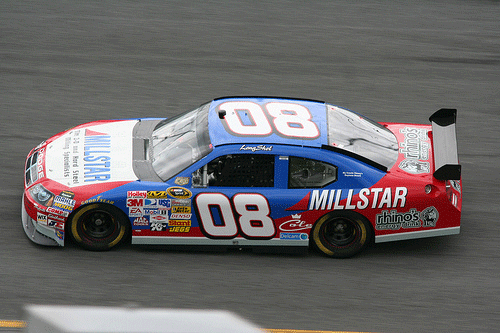
Carl Long Millstar Dodge Charger Image courtesy of The Freewheeling Daredevil via Flickr.com

How much is 0.17 cubic inches worth to you? If your name is Carl Long, the answer is: much more than $200,000. That’s the monetary fine (the largest in NASCAR history) that Long received last week for running with an engine that was 358.17 cubic inches in volume, just 0.17 inches above the NASCAR limit. For Long, who was in 63rd place before the suspension, the fine is just the beginning.

The fine was technically levied to Long’s crew chief Charles Swing (who has sincebeen admitted to the hospital for heart problems), but will be paid by the car’s owner, Danielle Long, (yup, Carl Long’s wife). Along with the fine, Long was also suspended for twelve races and docked two hundred driver points in the NASCAR Sprint Cup. Suffice to say, he’s had a rough week.

Engine size has historically been a point of contention in NASCAR, as engines apparently wear enough throughout the races to cross the acceptable line. In Long’s case, his car blew an engine during practice last week, providing NASCAR with the opportunity to inspect it. The engine was sent to the R&D lab, where it was determined to be 0.04 percent out of spec.

Long offered, on his website, this explanation:

“We purchased an engine from a reputable builder at the beginning of the season. We overheated the engine in practice and had to change it. We had the option to withdraw and go home before admitting it to inspection. Trusting that our blown engine wouldn't have any problems passing NASCAR tech, we submitted it and put our other motor in the car to get ready for the Showdown. As everyone knows, it didn't pass tech. The rules are 358 cubic inches and ours is 358.17 cubic inches. The .17 is as wrong as if it would have been 400 cubic inches. This engine is 50 horsepower less than top teams but it was all that could be afforded. I would have never knowingly went to the race track with a big engine!!!”

Bloggers, along with Burton Smith, the owner of eight NASCAR race tracks, appear to support Long (you can even virtually sign a petition in his favor).

Smith said, "Why would you fine this man $200,000 for an engine that's a little bit over? We've seen that so many times. What is it proving? I don't know who made that decision. ... In my opinion, they're dead wrong. Some of the things that NASCAR can do can disrupt and ruin a person's reputation, ruin their career. Two hundred thousand dollars? I've seen in the past where your engine may be a little bit over and maybe they take the engine."

"I don't know Carl Long, but there's an injustice done there," Smith also said. "I hope he wins his appeal. He can't race for 12 weeks? That's so cruel to try to ruin this man. That would absolutely financially ruin him, and it's just not right. I think you can prove your point a better way than that."

What do you think, PopSci readers? Were the fine and penalties fair?

Want to keep track of the latest concept cars, automotive innovations, and more? Subscribe to Popular Science and enter to win $5,000!

7 Comments

bdhoro87

from coral gables, fl

I wouldn't say that the fine/penalty is fair, but there needs to be a rule, and the line must be drawn somewhere. Anyway, you gotta follow the rules if you wanna play the game, and he broke them knowingly or not. Really Long should take it up with his so called "reputable builder" who should be liable for meeting the standards on engine size. I sympathize, I mean he clearly didn't purposely cheat to gain the extra .17 inches and thats a huge fine but rules are rules.

I would support this penalty if NASCAR routinely handed out huge penalties for tiny infractions -- but they don't.

I wonder what would have happened if they found this violation on one of the big teams' cars. My guess is that they would just quietly ignore it.

I don't know why they're pounding this guy, but I think that it's something other than the 'oversized' engine.

BTW, if I did this right ( and I used Excel), this oversize could be caused by each cylinder having a diameter slightly less than a thousandth of an inch over.

This is the most ridiculous thing I've ever heard, his engine didn't pass inspection, because it was blown!

When an engine overheats all of the parts grow, the cylinders become egg shaped, bolts stretch and become loose, and you lose all of your tolerances.

When the engine cools after overheating, the engine parts WILL NOT be the same size or shape.

Did the inspectors take that into consideration?

I agree this is kind of ridiculous. But then it gets you thinking was that engine made by GM or ford? If so was it ordered slightly bigger or does GM and ford not have the ability to make engines to specs within .17 inches.

Even though I am sure aadaily is is correct, the perception by some may not realize this.

http://wheresthestripclub.com"

That is Ridiculous. Cause having .17 cubic inches too long is going to give you that extra push to beat everyone else!
F**k NASCAR!!

Carl Long's engine is legal, if NASCAR's engine rule states specifically that 358 cubic inches is the limit. Then 358.17 cubic inches is legal. The significant digits in the limit dictate that which is used when reporting the test result after all calculations have been completed. So 358.17 is reported as 358 if the 8 is the last significant digit.

If NASCAR's limit is 358.0, then and only then does Carl Long's engine warrant a fine.

This is basic junior high math. All of the scientific community, the Federal Government and essentially the rest of the world utilize this method of reporting.

Penis büyütücü

Popular Tags

Regular Features


Download Our iPhone App

Stay up to date on the latest news of the future of science and technology from your iPhone with full articles, images and offline viewing


Follow Us On Twitter

Featuring every article from the magazine and website, plus links from around the Web. Also see our PopSci DIY feed


Become a Fan On Facebook

Share links with friends, comment on stories and more


December 2009: Best of What's New

In our December issue, Popular Science names the 100 best innovations of the year: bombproof wallpaper, self-parking cars, the fastest helicopter, and 97 more. Plus inventor profiles and videos.

Check out the best of what's new here.

Popular Science Photo Pool


Share your photos in the Pop Sci pool at www.flickr.com!
tags_sprite.png
POP_embeddedForm_cover_May09.jpg