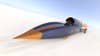
More than a decade after the Thrust SSC project exceeded Mach 1 on land, Richard Noble and company plan to go really fast
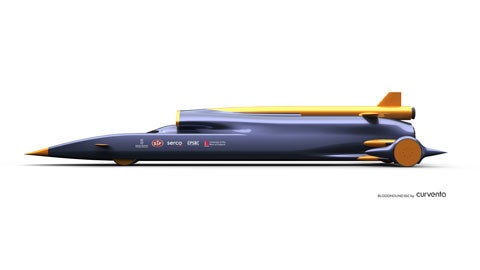
Bloodhound SSC
1,000-mph Car? The Bloodhound SSC A scale model of the Bloodhound SSC, a jet-powered car designed to exceed 1,000 miles per hour. Curventa

Back in 1997, RAF wing commander Andy Green proved breaking the sound barrier on land wouldn't destroy the universe. Now, a successor to the ThrustSSC, the jet car Green piloted a decade ago on Nevada's Black Rock Desert, is in the works. Target: 1,000 mph.

It's dubbed the Bloodhound Project, a three-year effort headed by ThrustSSC developer Richard Noble. Noble will again tap commander Green, who reached 763 mph in the Thrust car, powered by twin Rolls-Royce Spey turbofan engines from the British F-4 Phantom II jet fighter. The Bloodhound SSC vehicle is expected to reach Mach 1.4, marking the greatest incremental increase in the history of the World Land Speed Record. A press release claims it will also exceed the low altitude speed record for aircraft of 994 mph. The release also highlights specs as follows:

""The 12.8m long, 6,422kg (fueled), jet and rocket-powered vehicle will be more advanced than most spacecraft and faster than a bullet fired from a handgun. Its 900mm diameter wheels will spin at over 10,000rpm, generating 50,000 radial g at the rim. The car will accelerate from 0 – 1,050mph in 40 seconds and at V-max (maximum velocity), the pressure of air bearing down on its carbon fibre and titanium bodywork will exceed twelve tonnes per square metre. At this speed, Andy Green will be covering a distance equivalent to over four football pitches every second, or 50m in the blink of an eye."

It's not just about winning a numbers game. Proponent Lord Drayson, UK Science Minister, says it's about inspiring the next generation of British aerospace engineers.

In addition to sponsorship funding from Swansea University, STP, Engineering and Physical Sciences Research Council, Serco and the University of The West of England, the team must raise 10 million pounds, or more than $16 million.

To see more images, click here.


[via Bloodhound SSC]
Want to keep track of the latest concept cars, automotive innovations, and more? Subscribe to Popular Science today, for less than $1 per issue!

13 Comments

Ummm... I want one.

This sounds so cool. I wonder where they are going to do this. The Utah, Salt Flats are a great place. I have seen documentarys on people breaking land speed records there. It is pretty cool. One last question. How do they qualify this as just a car? I would almost say that this is strictly a rocket. Is it because it has wheels and does not go into the upper atmosphere? If anyone could answer this question it would be great.

That would be sooo cool!! As for your question akrembug, i don't know. But you might get some ideas if you go to wikipedia. Look up car, and rocket. Hope this somewhat helps.

wow, risky! If you're in a supersonic plane at altitude and it comes apart at the seams, an escape capsule can save you. But if you're in a 1,000 mph rocket car and it goes out of control just inches from the ground, your survival is much more threatened. I wish Green luck!

Hmmmmm these are so cool i would like one but i wonder, what is this all for?

Glory?

How are we going to use this technology to help everyday life?

I think it would be better to put the money to better things and after all once u go fast, faster and fastest you cant go any faster. It would either rip apart or fly of the ground like billdale said, be obliterated and kill the pilot.

Im just saying.

-THE KID

Setting records like this provide lots of engineering knowledge, it's the same reason major cars companies always have racing teams to test engineering extremes. What they learn on the track gets incorporated into their products, and what is learned from this speed record attempt will be inspiring and useful to aerospace engineers. Plus its badass, and thats enough for me.

WOW. 1000 miles? WOW!

thats just crazy.

why are we putting so much time, engergy, engineering, and record breaking to make a supersonic car that cant be used as a common household car?

Wow this is a crazy car. However I still don't get how much knowledge we can gain from this experiment. Since this car is pretty much a rocket running on the ground. If it is for structure/material testing, well the X-15 have reached 4500 mph already and survived, so what kind of knowledge we can gain from this barely 1.5 mach vehicle? Ground effect?

The idea of this project is to be open source, the spec sheets and data will be available to anyone and anyone can contribute. if you think you design a hinge for an airbrake to operate at Mach 1.5 then submit it. The idea is get people involved so its not an isolated event. In Britain there is a distinct lack of scientists and engineers training.

There are several land speed records that fall into different categories, this one is a free wheeling car (no power is fed to the wheels) Also britain is aiming for the steam car record a staggering speed of 170mph. So the Bloodhound is a car of sorts, it does have a V12 motor although that is just a pump engine!!

I know we could be putting the time to better use but this is a team building exercise, getting people to work together for a common goal.

Oh BTW the Thrust SCC was to have and ejector seat but was deemed to heavy so was scrapped, I think if this Bloodhound was to go wrong you wouldn't have much time to react!!

But if it goes wrong , there'll be little more than a red smear across the salt flats. But I'm sure they'll make it.

ABOUT THAT 1000 MPH CAR: Please, please, please - add a bigger tail and put the rear wheels farther apart.

I know a thing or two about driving at speed and the pressure on the nose is many times that of the pressure at the rear! Trying to push a tail-less rocket car without a tail at over mach-1 is like trying to fly an arrow tail first - it will always want to try to spin around. At that point its going mach 1 sideways and that's when the ride ends real fast.

As for the wider wheels: There is an incredible amount of roll oscillations that set in and with the wheels placed together so narrowly, they simply cannot dampen it out. That baby as its currently designed will probably hit a small bump at speed, and the roll-oscillate until its on its side. For great stability, put the wheels out at the tips of small wiglets, so that they are much wider apart (wide 1/3 as the car is long), put them inside of wing-like flarings, and use these flarings as the stabilizer tails that this vehicle needs. If you make these changes, then there will be no problems.

Another thing: Don't do the trial runs with a human inside of it. Use remote controls and teleremote driver. This way if the thing cracks up during tests, nobody will get hurt. Its one thing to win a world's record but another thing when you take the world away from a family by killing their father - the test pilot.


June 2013: American Energy Independence

Five amazing, clean technologies that will set us free, in this month's energy-focused issue. Also: how to build a better bomb detector, the robotic toys that are raising your children, a human catapult, the world's smallest arcade, and much more.


Online Content Director: Suzanne LaBarre | Email
Senior Editor: Paul Adams | Email
Associate Editor: Dan Nosowitz | Email
Assistant Editor: Colin Lecher | Email
Assistant Editor: Rose Pastore | Email

Contributing Writers:
Rebecca Boyle | Email
Kelsey D. Atherton | Email
Francie Diep | Email
Shaunacy Ferro | Email

circ-top-header.gif
circ-cover.gif