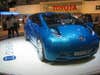
The weeklong 2008 British International Auto Show started yesterday and through the Lightnings, Citroens and, yes, Ford Fiestas one common thread has stretched; and it is green. Most of the low and mid-range manufacturers addressed the public’s clarion call for less reliance on pricey fuel.
Citroen’s tiny turbodiesel engine nets 80 miles a gallon, for instance, and plenty of manufacturers rolled out battery-based concepts. The luxury automakers mostly stuck to their high-horsepower, blazing-speed model. But then again, if you can afford a Bentley, what’s another five bucks a gallon?
Launch our gallery here for the entire shiny roundup along with John Voelcker’s on-the-scenes reporting from the 2008 London Motor Show.
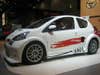
TOYOTA AYGO CRAZY
This “crazy” one-off boy-racer concept is meant to add pizzazz to the Aygo, Toyota’s smallest European car. It combines an Aygo body shell, or most of it, with a purpose-built chassis, a full roll cage, and a mid-mounted 1.8-liter turbocharged engine putting out 197 horsepower and driving the rear wheels. It’ll do 0-60 in less than 6 seconds.
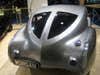
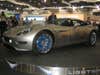
MORGAN AEROMAX
Morgan treasures its image as the last of the British eccentrics, offering wood-framed open cars with wire wheels—albeit also compliant with crash and emissions rules. But purists took years to recover from the 160-mph Aero 8 supercar, using all-alloy construction and a 330-hp BMW V8 engine to blaze from 0 to 60 in 4.5 seconds. More jaws dropped this year at the classic beauty of this Aeromax closed coupe.
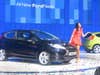
CITROEN C-CACTUS
No show would be complete without a bizarre French concept or two, including loads of immaculate spokesmodels. This is Citroen’s C-Cactus, a large and futuristic four-door with a tiny turbodiesel that delivers a bit more than 80 miles per gallon and take you to 93 mph, courtesy of its very light weight (2600 lbs) and excellent aerodynamics.
OPEL/VAUXHALL INSIGNIA
The show’s important global launch was GM’s Insignia, sold as a Vauxhall in the UK, an Opel elsewhere in Europe, and possibly a Saturn in the States. The midsize sedan and hatchback offer a drag coefficient of just 0.26, adaptive all-wheel-drive, nine different positions for adaptive headlights, and a camera system that reads not only lane markings, but road signs too.
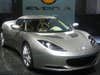
LOTUS EVORA
The other global release was the Lotus Evora, the only 2+2 in the world with a transverse mid-mounted V6. It puts Lotus into competition with the Porsche 911 and other pricey, luxurious coupes. Images of the car hit the Internet a few days before the show, but the name Evora stayed secret until the very end.
LIGHTNING GT
Just another fast V-8 or V-12? Not quite. The Lightning, an all-electric British sports coupe unveiled to an eager hometown crowd, does 0 to 60 in less than 4 seconds courtesy of four 120-kW wheel motors, powered by 36 kWh of AltairNano lithium-ion batteries. Though videos of the car during track testing were shown, much remained to be finalized—including the company’s financing.
2009 FORD FIESTA
As for high-volume global cars, Ford’s usual singing-and-dancing hoopla revealed the new Fiesta. Singing star Alesha Dixon and backup dancers unveiled the car amidst pounding music, strobe lights, smoke effects, and confetti. On the green end of the range, the Fiesta ECOnetic returns an astounding 61 mpg from its 1.6-liter turbodiesel engine. Its CO2 emissions of 98 g/km, in fact, exempt it from British Road Tax (annual registration) altogether.
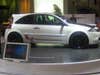
RENAULT MEGANE R26-R
After lengthy preliminaries on carbon reduction and a transcontinental minivan trek, Renault managed to launch the hot-rod version of its front-wheel-drive Megane coupe. Surprisingly dull-looking in white, this road-legal track racer strips the interior down to two seats and packs a 227-hp 2.0-liter turbo four, six-speed gearbox with short-throw stick, and a limited-slip differential.
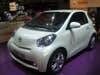
2009 TOYOTA iQ
It wasn’t all hot rods and sports cars. The iQ coupe takes Toyota into Mini territory, carrying up to three adults plus a child. Lauded at shows around the globe, the 118-inch-long car goes on sale late this year. Its small size belies surprising interior room, and it received the top rating of five stars in European crash testing.
TOYOTA HYBRID-X
London wasn’t the first appearance for this 18-month-old concept. But the Hybrid-X is significant because it previews the shape of the eagerly awaited 2010 Prius hybrid-electric. With extreme aerodynamics, a glass roof defined by two metal hoops (hence the “X”), it’s as futuristic as the current model was in 2003. No powertrain info, though, and don’t hold your breath for the rear-hinged doors.
BRABUS BULLITT BLACK ARROW
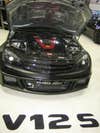
Hot rods always earn big crowds at auto shows, and London had more tuners than most. German speed freaks Brabus brought their Bullitt Black Arrow, which drops a 720-hp twin-turbo V-12 into the innocent body of a Mercedes-Benz C-Class sedan. Included are flat-black paint, a host of luxury appointments, and an electronic torque limiter that keeps the car to a mere 224 mph.
HONDA CIVIC TYPE S
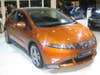
And what’s this rounded rocket that looks like a spaceship? A Honda, you say? In fact, it’s the European version of the Civic, highly coveted by US Honda fans for the performance of its 2.0-liter engine putting out 198hp, its six-speed manual, its go-kart handling—and just the sheer looks of the thing, from the full glass roof to the front light bar.
HONDA FORMULA 1 RACER
Just to underline its sporty credentials, Honda stuck one of its Formula One cars into the display. The green message and globe image on a screamingly fast competitor in the world’s most extreme races perfectly underlined the existential tension of this year’s London Show: Which is cooler, low-CO2 vehicles or fast, sporty road cars?
SMART ED
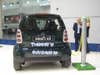
Right at the front of the “EV Village,” the Smart ED (for electric drive) provides a range of 50 to 70 miles from a 26.4-kWh sodium-nickel-chloride battery driving a 30-kW motor. Acceleration from 0 to 30 mph (yes, 30) is quoted at 6.5 seconds, with a top speed of 60 mph. A trial of 100 cars began last year, and Smart will sell or lease the car to retail customers in the near future.
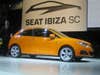
SEAT IBIZA SC
This crisp, expressive coupe from Spain’s Seat brand was well received by press and public alike. With the tagline “autoemocion,” Seat is the most distinctive of the VW Group’s many brands sold outside North America. Most buyers never know the Ibiza is a Volkswagen Polo supermini underneath (one size smaller than the Golf/Rabbit line).
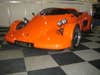
KAMALA K360R
No British auto show would be complete without a slew of low-volume, high-performance cars aimed at die-hard enthusiasts and madmen. The Kamala’s calling card is a 0-60 time of three seconds when fitted with a highly turbocharged version of Ford’s 2.0-liter Duratec engine mounted behind the driver. It’s really meant for track usage, but a road-legal package is available.
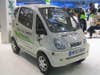
QUIET CAR 1
Back in the EV Village, only a handful of the 10 vehicle brands on display could be considered “real cars”. This one probably couldn’t. Even with a lithium-ion battery pack (no capacity given) to giving it a range of 60 miles at up to 40 mph, the claim of 2+2 seating sounds frighteningly cramped. It really is as small (and narrow) as it looks.
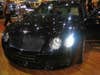
BENTLEY FLYING SPUR SPEED
And finally, it wouldn’t be British without a Bentley, would it? The fabled marque—now owned by Volkswagen, mind you—launched its Flying Spur Speed, a sedan using the running gear from its Continental GT Speed. With 600 hp from a twin-turbo W-12 engine, and all-wheel-drive, it’s luxury at the limit.
HONDA FORMULA 1 RACER
Honda is already out of F1. Now the FOTA teams, including Ferrari, BMW Sauber and McLaren Mercedes, have announced they are off as well.