Design: The Guru of Impossible Engineering Creates a Car
What would happen if an architect renowned for his unruly, twisted-metal structures decided to craft a new kind of automobile? We´re about to find out.
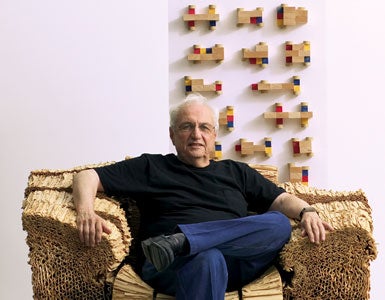
Two years ago, Frank O. Gehry strapped himself into the driver’s seat of a V8 Dodge Dakota pickup with bald rear tires and drove onto a skid pad at the Mazda Raceway Laguna Seca in Monterey, California. It was a clear day, but the pad’s surface was wet, and within seconds he was sliding out of control-which was the point. Gehry-the world-renowned architect of the titanium-clad Guggenheim Museum in Bilbao, Spain, and the Disney Concert Hall in Los Angeles-had come to this Skip Barber Racing School along with a group of researchers from the Massachusetts Institute of Technology to learn the tricks of the pros: skid recovery, heel-and-toe downshifting and the advanced braking techniques of Formula 1 drivers.
“It was scary,” the 75-year-old architect says of the 110-octane weekend. But he wasn’t there for the adrenaline rush. He was there to research a new project: building an automobile. Gehry is collaborating with the MIT Media Lab to design a concept car unlike anything Detroit would produce by itself.
The idea is to leverage the Media Lab’s knowledge of advanced technologies and Gehry’s knack for building the impossible to produce a vehicle that challenges the conventional wisdom of how a car is designed and what it can do. General Motors, a Media Lab sponsor, has signed on to provide technical support. “GM knows how to design automobiles, and it does that very well,” says William Mitchell of MIT, a professor at both the school of architecture and the Media Lab, in whose classroom the concept-car idea was concocted. “But it’s hard to step out of the box. That was our mandate.”
Ever since Harley Earl, GM’s first design chief, unveiled the company’s earliest concept cars-including the LeSabre of 1951, with its fully automatic convertible top-the industry has used show cars to hint at the future. But prophesies can be wrong. In hindsight, the bold vision of the 1956 Firebird II-a turbine-powered, titanium-skinned prototype engineered for the automated highways of tomorrow-showed a naive optimism. “If you go too far out, you lose credibility,” admits Wayne K. Cherry, who recently retired as GM’s vice president of design but is on contract to see this project through. “But if you don’t go far enough, then why bother?”
Gehry frees walls the way Jackson Pollock freed paint. His swirling, curvilinear forms pushed the technical boundaries of 20th-century architecture and forced steelworkers, roofers and others to reinvent their crafts. Seen from the surrounding hillside, the Guggenheim Bilbao unfurls in metallic waves; closer up, you can see the 0.38-millimeter-thick sheets of titanium almost flutter. Some observers have called it the first building of the 21st century. More recently, Gehry has earned headlines for the steel-clad Walt Disney Concert Hall and for MIT’s Stata Center, with its tilted brick towers and crumpled metal.
An unconventional approach to materials has defined Gehry’s career, yet it has also earned him derision, especially in the early years, when he experimented with chain link and plywood. “Being accepted isn’t everything,” he once said. His reputation grew, and in 1989 he won the Pritzker Prize-the Nobel of architecture-though it was the 1997 Guggenheim Bilbao that brought him worldwide celebrity.
Gehry’s work is enabled by a software tool known as CATIA, which stands for “computer-aided three-dimensional interactive application.” Gehry discovered it while experiencing a frustrating false start on the Disney Concert Hall, which he first designed in 1990. The hall’s curved facades seem almost tame post-Bilbao, but back then, such warped structures had never been realized. Gehry was trusted to serve only as the design architect at the time; an executive architect was hired to translate his two-dimensional designs into detailed construction documents. Based on those documents, which did not accurately represent Gehry’s plan, projected construction costs spiraled out of control, and in 1994 the client balked. In the meantime, Gehry’s partner Jim Glymph had joined the firm and, exploring ways for Gehry to better document his designs in three dimensions, found CATIA.
The program was originally developed in France by Dassault Systmes to assist aerospace engineers in building complex curved shapes. Although CATIA is now the industry standard for auto engineers, it is not generally used by their colleagues in the design department. That’s because the software’s strength is in making fine mechanical and engineering adjustments; it doesn’t allow for intuitive sketching and image-driven studies. CATIA is a parametric system: The relationships among components are built into the model. When a designer makes a change, all the other components that are affected by that change are adjusted automatically in a sort of ripple effect-the axles lengthen, for instance, when the car gets wider. The software can also simulate the behavior of various materials under stress.
Gehry still starts his design work by making sketches and physical models. But as the building’s form solidifies, those prototypes are digitized and converted into CATIA models. This gives Gehry unprecedented control over not only design but construction: Contractors download the CATIA models directly into milling machines, laser cutters and other computer-controlled manufacturing equipment.
The hope is that Gehry’s tech-assisted daring will yield a car that’s as fresh and surprising as his buildings. But the goal is not a Bilbao on wheels. The car’s engineering is being developed by a team of MIT students-from the Media Lab and the school of architecture, along with one stray neurobiology postdoc. They are looking beyond aesthetics to features such as novel chassis designs, new suspension systems, alternatives to the seatbelt, and hubless wheels.
GM has collaborated with several unlikely designers in recent years. In 1992 the company unveiled the 1,400-pound Ultralite concept, developed with aviation pioneer Burt Rutan. The innovative aluminum structure of last year’s Cadillac Sixteen was built in partnership with Alcoa. And the sporty Hummer H3T was created with help from Nike.
“Anytime you ask a nonautomotive designer to create a car, you end up with something different,” says Frank Saucedo, design director of GM’s North Hollywood studio. “The stuff Gehry is doing in his buildings, those motion-induced shapes-a car designer thinking about aerodynamics would never make that, so we may see a very fresh vocabulary emerge.”
Gehry, who has designed watches, chairs, even a line of doorknobs, says this challenge holds particular appeal. “When you think about it,” he muses, “the car represents so much about American society. It’s got social issues. It’s got style. It’s got symbolism. So it’s fascinating from that standpoint.”
For GM, the project provides a rare opportunity. Bottom-line pressures have forced the Big Three to cut costs by streamlining the manufacturing process. A few years ago, GM had 40 kinds of door handles in its parts bin; today it has five. The company is also building cars as different as the Corvette C6 and the Cadillac XLR on the same basic architecture, leaving less leeway for radical design or engineering innovations.
Moreover, the company’s concept cars-with the exception of the breakthrough Autonomy and its second iteration, the Hy-wire-are now closely aligned with its production vehicles. “Concept cars have become strategic messages that aren’t about getting the public to dream,” says Geoff Wardle, the acting chair of transportation design at the Art Center College of Design in Pasadena, California. “They are more of a test bed to see how a design direction or new technology will be perceived.”
The Gehry creation will be another sort
of concept car. It is unlikely to turn into a new line of production vehicles, but the exercise may inspire some dreaming. “The car industry needs so much help in extracting itself from its view of how a car should be designed,” Wardle says. “Just the fact that Gehry is doing this will stir people up and get them thinking.”
Gehry is more circumspect. “It’s not likely that a creature from another culture is going to come in and come up with anything new,” he says. “The only thing that’s possible is that you bring to it a new way of looking at something. You ask stupid questions, and that might trigger ideas.”
Seated in his spacious corner office on the fourthfloor of the MIT Media Lab, William Mitchell is discussing triangular wheels. It’s an inauspicious, if not absurd, starting point, but his students still produced several solutions-including an equilateral triangle with arced sides and a central gear that ensures that the axle remains the same distance from the ground. “We didn’t spend much time on that, though,” Mitchell says. “We had more important things to get to.”
That was last September, three years after one of Mitchell’s Ph.D. students, Ryan Chin, proposed that the Media Lab build a concept car. Mitchell ultimately convinced Gehry, an old friend and occasional co-teacher at MIT’s architecture school, to sign on. GM, already a Media Lab sponsor, agreed to provide engineering support and to build the vehicle. Mitchell’s goal was to have his students finish basic R&D in a year, leaving another year for Gehry to create his design.
In consultation with GM and Gehry, the student team began with certain assumptions: The car would be drive-by-wire: Mechanical linkages would be replaced by digital connections. And it would incorporate a hybrid or fuel-cell propulsion system. Everything else was to be determined.
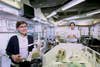
Their first step was to build crude digital diagrams of possible chassis configurations-including where the passengers sit and the placement of doors and wheels. Axel Kilian, an architecture Ph.D. candidate, then camped out in Gehry’s product design studio to make prototypes of each configuration for the architect to play with. Back in Massachusetts, the students built hundreds of scrappy models of their own, from metal screws, foamcore, plaster, starch, welded copper wire and even plastic Easter eggs. They mocked up a driver’s seat and connected it to a PlayStation running Gran Turismo for full driving effect. They made miniatures of wheels and other parts on the stereo lithography machine in the basement.
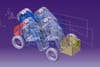
At the same time, the team was using CATIA to build 3-D digital models of the car. During my visit, Kilian offered to show me how the software works. He clicked open a drawing of a three-seater with the driver and a passenger in front and a second passenger between them in the second row. Then he dragged the third seat behind the driver, making it float outside the car’s tapered body, and slooowly the model
shifted the car’s form-reshaping the shell, widening the rear wheel base. Next Kilian narrowed the car so that there was no longer room to house three hydrogen storage tanks side by side. The system reacted again, raising the height of the passenger compartment and stacking the hydrogen cylinders.
In June, after an academic year’s worth of R&D and a week of sleepless nights, Mitchell’s group opened a work-in-progress exhibition of the concept car. Visitors to MIT’s Wolk Gallery previewed new propulsion systems, drive-by-wire interfaces, vehicle architectures and a smart outer “skin” with networked, embedded intelligence. The posters and prototypes lining the walls-physical answers to scores of what-if questions that Mitchell’s team had considered over the course of the year-were intended to serve as fodder for Gehry, techie starting points from which he could begin his design.
Some of the renderings in the exhibit illustrate novel surface materials. Organic light-emitting diodes (OLEDs) are a low-power display technology that is self-luminous and thus requires no bulky backlighting. An OLED skin could be programmed to change the color of the car or to indicate where the driver is looking; it could make mechanical indicator lights and metal license plates obsolete. Other drawings on display show the students’ idea of the “soft car,” covered with a flexible, quilted plastic foil called ETFE (ethyltetrafluoroethylene). This material is layered, and the spaces in between are filled with air the way a down comforter’s feathered squares are. The car would have a hard inner shell to protect passengers, and the soft ETFE-based outer shell would allow for bumper-car-like traffic patterns that the MIT team has termed “gentle congestion.”
In another concept on display, a lightweight passenger compartment is suspended from the car’s exoskeleton. Decoupling the passenger cabin from the car body creates opportunities for more flexible designs. It also allows for new safety features. Today’s auto bodies are built with crumple zones that compress during an accident and absorb the energy of the impact. In one proposed additional safety system, the cabin hangs from an internal ceiling beam and a layer of fluid separates it from the car’s exoskeleton. In a collision, the swinging of the cabin and the fluid buffer would act as shock absorbers. Mitchell’s group is patenting yet another safety feature: a robotic “wearable seat.” In a crash, the edges of the seat wrap around passengers in a partial embrace, far exceeding the protective power of seatbelts and airbags.
The group is also trying to patent a new wheel design. In 1990 Osmos, a French company, introduced the hubless wheel, in which steering and braking components are integrated into the outer ring. The MIT team pushed the idea further, proposing to locate an electric motor and suspension within the empty wheel space. This reduces the vehicle’s unsprung mass (the part of the car’s mass not supported by the suspension), making it more stable. The motor wheel also enables tighter steering, leaves more space for people and bags, and lets the wheels attach to the body in new ways. “The car could have omnidirectional steering,” Chin says. “You could pull up next to a parking space, turn your wheels 90 degrees, and drive in sideways.”
From the renderings on display, it’s clear that the Media Lab group drew inspiration from GM’s Autonomy and Hy-wire. Those concept cars housed all the equipment needed to make the car run-fuel supply, fuel cells, electric motors-in a flat chassis (11 inches thick in the drivable
Hy-wire, just six inches thick in the more pie-in-the-sky Autonomy) onto which various auto bodies could be placed. In addition, the MIT students have suggested a possible automotive application of social-networking services such as Friendster. Looking for a parking space? A friend of a friend is leaving one. Such networking capacities, Mitchell says, will give the car “the collective intelligence of London’s taxi drivers.”
In midsummer, after the MIT exhibition closed, Mitchell took stock. He had never expected to end up in discussions with MIT’s patent office. The motor wheel, in particular, had promise. It fit with a vision of our automotive future in which cars will be made of discrete elements (passenger cabin, suspension, exterior), any of which can be swapped out-and therefore customized. Drivers might someday be able to sport standard wheels for commuting and then pop on stylish ones for weekends. Mitchell realized that with more development, his students’ concepts could become licensable technologies. He decided to give the team six more months to refine their engineering ideas. So for now, Gehry’s work will have to wait. Some concept cars preview the future; others parody it. But at the big auto shows, amid the flashy lighting and fog machines, they all reflect the unbridled potential of emerging technologies. A soft car with motor wheels sculpted in Gehry’s swooping curves that finds its own parking place? You won’t be driving it in five years-and indeed, it’s possible that, like the Firebird II, it will never be built. But there’s no reason its modular structure and smart skins won’t eventually appear in production vehicles, just as the LeSabre’s automatic folding top is now standard. As pioneering computer scientist Alan Kay once said, “The best way to predict the future is to invent it.”
Jessie Scanlon writes for I.D., Slate and other publications.

by Andy Ryan
Materials Man
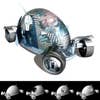
The Bubble-Like Soft Car
Driving Force

The Accordian Car
by John B. Carnett
Geometry in Motion
by John B. Carnett
by Jeff Sciortino