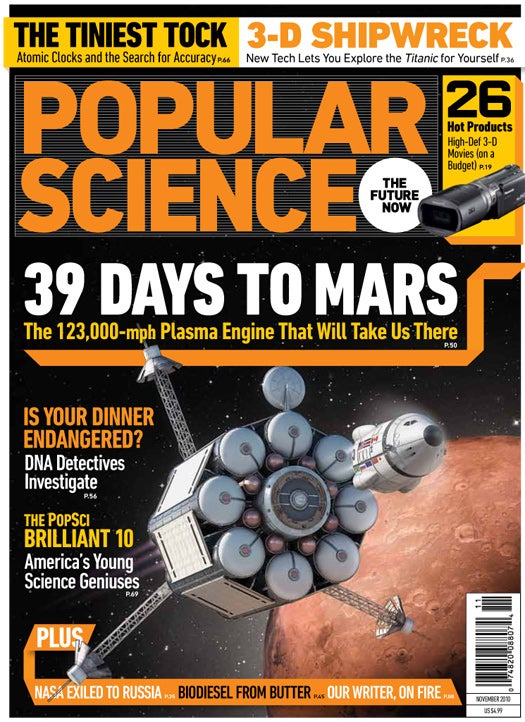
November 2010: 39 Days to Mars
The PopSci Brilliant 10 young geniuses, high-def 3-D cameras on a budget, endangered dinners, and more
Features
39 Days to Mars
The 123,000 MPH Plasma Engine That Could Finally Take Astronauts To Mars** By Sam Howe Verhovek**
How It Works: How Physicists Use Strontium To Slice A Second Into Thinner Slivers
Measuring time more precisely than ever** By Erika Villani**
Is Your Dinner Endangered? DNA Detectives Investigate
Scientists deploy genetic forensics to protect overhunted animals By Laura Allen
Brilliant 10
Your guide to America’s young science geniuses
- Brilliant 10: Katherine Kuchenbecker, the Puppet Master
- Brilliant 10: Michael Bartl, the Nano-Ranger
- Brilliant 10: Christopher Love, the Cell Tracker
- Brilliant 10: Raul Rabadan, the Outbreak Sleuth
- Brilliant 10: Ian Spielman, the Control Freak
- Brilliant 10: Santosh Kumar, the Sensor Guru
- Brilliant 10: Sarah T. Stewart, the Master Blaster
- Brilliant 10: Chiara Daraio, the Sound Magician
- Brilliant 10: Iain Couzin, the Pattern Maker
- Brilliant 10: Maurizio Porfiri, the Water Wizard
Headlines
- Budget Cuts And Outsourced Training Could Put NASA’s Astronauts At Risk
- –>How Robot Submarines Are Imaging The Titanic in 3-D
- Affordable DIY MRI Shows How We Really Breathe
- Wireless System Tracks Deadly Bacteria In Hospitals
- New Plan Could Turn Dirty Grease and Dairy Into Biofuel
- Which Humanoid Robot Stands Up Best In Space?
What’s New
- The Goods: November 2010’s Hottest Gadgets
- Electrocardiogram-Equipped Cell Phone Allows Remote Monitoring
- Inflatable Motorcycle Suit Provides Instant Protection
- Tracking Technology Makes U.S. Bike Sharing Services More Secure
- Portable Digital Music Studio Packs In Tons Of Features
- Affordable 3-D Cameras For Amateur Photographers
- Cousin Of The Chainsaw Engine Could Power 100-MPG Car
How 2.0
- Software Engineer Builds Supersize, Computer-Operated Robotic Chess Set
- Gray Matter: In Which I Set Myself On Fire
- A Free Media Center Run By Open-Source Software
- Ask A Geek: How Can I Bring My Computer With Me on a Thumb Drive?
- Simple Project Of The Month: A Dashboard Phone Mount
FYI
- FYI: Could We Use The Soon-To-Be-Retired Space Shuttles As Space Stations?
- FYI: What Would Happen If Every Element On The Periodic Table Came Into Contact Simultaneously?
Megapixels
- Scientists Find Potentially New Worm Species In The Atlantic Ocean
- Different Surfaces Could Determine A Stem Cell’s Future
You can read the complete issue on your iPad with Popular Science+, subscribe to the print edition, or pick it up at newsstands everywhere